


The first scheduled flights


Fly to the seaside
From its early days, Deutsche Luft Hansa recognized the growing popularity of spa tourism as destinations for its domestic routes, establishing air travel as a fast way of reaching resorts on both the North Sea and the Baltic. On May 1, 1929, the company introduced return tickets with a ten percent discount, encouraging vacationers to take up the seasonal spa routes in particular, and stabilizing network capacity during the spa season.


Rapid rise
From its first routes departing from Berlin Tempelhof to the establishment of a pan-European network, Deutsche Luft Hansa grew rapidly into the 1930s. Night flights such as Berlin–Königsberg, as well as regular routes across the Alps, Pyrenees, Balkans, the North and the Baltic Seas, set technical and operational standards. Through joint ventures such as Deruluft serving Moscow and the Eurasia Aviation Corporation in China that was established in 1930, Lufthansa was an early pioneer of routes to Eastern Europe and Asia. As a result, by 1938, the company’s route network covered almost 80,000 kilometers, connecting Europe, Asia, and America via its hub in Berlin.
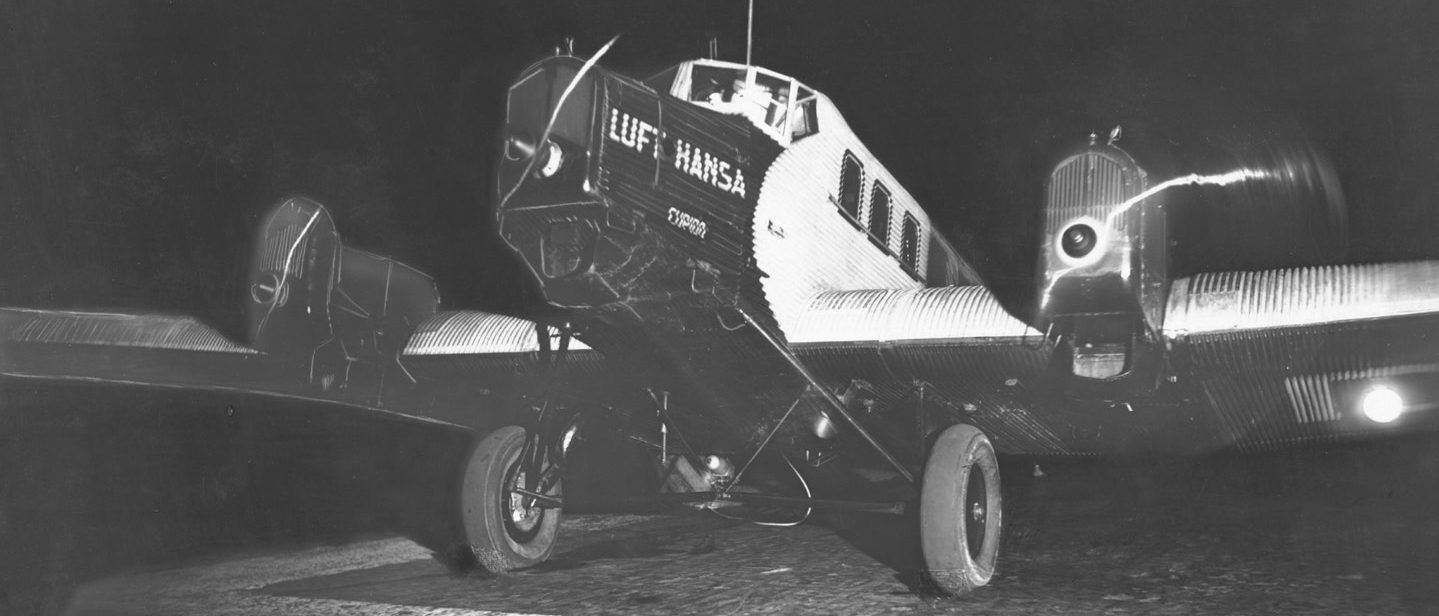
On May 1, 1926, Luft Hansa launched the world’s first night flight route, carrying passengers between Berlin and Königsberg (present-day Kaliningrad) on 3-engine Junkers G 24 aircraft.
Exploration, propaganda, and new opportunities
Lufthansa’s spectacular ventures and expeditions made the company a symbol of progress and pioneer spirit in the eyes of the general public. At the same time, these flights were testing out new routes. The flight to the Pamir Mountains in Central Asia in 1937 and the establishment of the South Atlantic airmail service provided crucial experience and are considered the direct precursors of scheduled intercontinental routes.
From selecting stopovers to assessing weather and altitude conditions, Lufthansa’s success in such pioneering flights created the operational conditions for a global route network in terms of both personnel and politics. This wealth of experience became even more important after the company was re-established in 1953. From early on, however, this growth was closely linked with Nazi policies that exploited these pioneering technical achievements for their own purposes.


When war broke out in 1939, Lufthansa was placed under state control by law. Parts of its fleet and infrastructure were repurposed for military use, scheduled civilian services were severely curtailed, and international flights were gradually phased out. A reduced route network serving neutral countries such as Scandinavia, Spain, and Portugal continued to operate for business representatives, diplomats, agents, and airmail services until operations were halted completely in 1945.
1933-1945
Lufthansa during National Socialism
The seizure of power by the National Socialists in Germany in 1933 saw the start of the darkest chapter in the history not only of the country but also of Lufthansa.
The first Lufthansa became part of the Nazi regime and participated in its military and criminal activities. Not everyone in the company, albeit far too many, actively supported this course of action. Before and during the Nazi era, Lufthansa profited from state subsidies and collaboration with leading National Socialists among other things. During the Second World War, the company trained pilots for the Luftwaffe and was involved in the production of munitions. Thousands of forced laborers, comprising up to 50 percent of the workforce during certain periods, were put to work under conditions that were both discriminatory and inhumane.
Lufthansa is also using the centenary of its founding as the opportunity to re-examine the company’s responsibility during the period of National Socialism. Insights into the role of Lufthansa during the Nazi era feature in the book Lufthansa – The First 100 YearsThe link will be opened in a new browser tab, written by three independent economic historians. In summer 2026 a new visitor center, Hangar One, will open at Frankfurt Airport showing displays concerning the Nazi period, among other exhibitions.
A new era in international aviation
Ten years after the end of the war, on April 1, 1955, a Convair CV 340 of the newly established Lufthansa, took off on a flight from Hamburg to Munich, while almost simultaneously another flight departed, traveling in the opposite direction. The aircraft had a capacity of 44 passengers and a maximum cruising speed of 430 kilometers per hour. These departures marked the beginning of a German domestic scheduled air service operating under special dispensation, as air sovereignty still lay with the occupying powers. The first postwar flight schedule comprised just four routes, but the network quickly grew to cover Western Europe.
As early as June 8, 1955, the Lockheed Super Constellation re-established Lufthansa on long-haul routes with a scheduled flight to New York. From this North Atlantic hub, the route network developed over the following years into an intercontinental system with a clear focus on transatlantic connections.


More routes to North and South America as well as to the Near and Far East followed in the second half of the 1950s, as Lufthansa’s management deliberately chose profitable transatlantic routes in order to re-establish itself as a latecomer to global air transportation.

Milestones in Lufthansa’s history
From the beginnings in 1926 with the first scheduled flight from Berlin to Zurich, to flights with the Pope and the football world champions: Lufthansa celebrates moments that have shaped aviation.

Curious cargo from 100 years of aviation history
From Siberian tigers and red pandas to a 72 VW Beetles in a Jumbo – throughout its history, Lufthansa has transported some of the most unusual cargo. Discover five surprising shipments that show just how diverse and exciting air freight can be.
The era of jet travel

The first Lufthansa Boeing 707 D-ABOB arrived at Hamburg-Fuhlsbüttel on March 2, 1960.
With the introduction of the Boeing 707 in March 1960, Lufthansa entered the jet age. The jet aircraft cut flight times on long-haul routes in half and enabled an increased number of flights, particularly between Frankfurt and New York. More long-haul services were moved to Frankfurt which, thanks to its location, developed into Lufthansa’s European hub, linked to a growing European feeder network.
From 1964 onward, the polar route via Greenland and the North Pole significantly reduced flight times to North America and strengthened Frankfurt’s position as a hub for North Atlantic air traffic. At the same time, Lufthansa revived its pre-war traditions of providing services to Eastern European and expanded its network to Asia, once again becoming the “number one airline between Europe and Asia,” alongside cargo routes operating the Boeing 707 freighter with a payload of up to 40 tons.


The crazy 1970s – with a clear allocation of roles
Lufthansa was the first European airline to launch a scheduled service between Frankfurt and New York, operated by a Boeing 747. The wide-body dimensions of the Jumbo Jet were thus introduced on the most important North Atlantic routes. With up to 361 seats, an inflight cinema, a lounge on the upper deck, and two aisles, the 747 became a symbol of growing long-haul capacity, serving as the carrier on high-demand routes. The long-haul fleet was complemented by the three-engine Douglas DC-10. This resulted in a clear differentiation within the route network: Jumbo Jets on high-traffic routes such as Frankfurt–New York, and DC-10s for less busy but strategically important long-haul routes.
In the 1970s, passenger and freight traffic grew significantly across the intercontinental network. At the same time, revenues came under pressure due to rising costs and currency fluctuations. The route network increased geographically to an unprecedented extent.

New horizons, new pressures
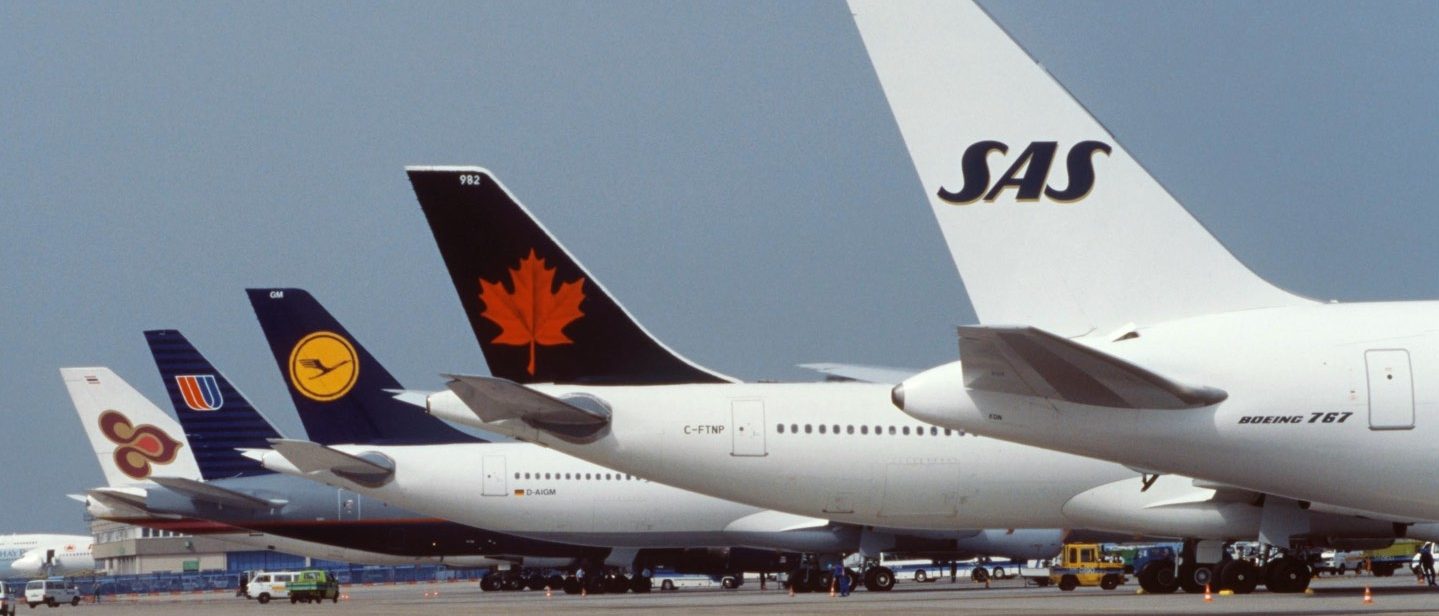
The 1980s and early 1990s were a decade in which growth, deregulation, and cost pressures all simultaneously contributed to expanding and streamlining Lufthansa’s route network. New generations of wide-body aircraft, such as the Boeing 747-400 and Airbus long-haul models, enabled more frequent nonstop connections, particularly on the Frankfurt–North America route.
From the early 1990s onward, the opening of Central and Eastern Europe brought new political opportunities as well as flights that integrated the former Soviet Bloc more closely with the Western European hub system. At the same time, destinations in Southern Africa and Central Asia – such as Cape Town, Windhoek, and Almaty – became regularly accessible for the first time. The focus shifted from simply expanding routes to intelligent networking: codeshares, partnerships, and – from 1997 onward – alliances became ways of extending Lufthansa’s services beyond the flight itself.
From hub to multi-hub system
From the 2000s onward, Lufthansa’s route network evolved into a group of several global hubs within the Lufthansa Group. Wide-body jets such as the A380, A330, A340-600, and 747-8, alongside the expansion of Frankfurt and Munich airports, strengthened intercontinental routes and made transfers more efficient.
Growth increasingly shifted toward alliances and acquisitions: SWISS in 2007, Austrian Airlines in 2009, and later Brussels Airlines with their own hubs and regional networks enhanced the Group’s network, while Lufthansa Regional and Eurowings brought new structure to feeder and point-to-point services. Digital services such as FlyNet® and new premium services at the hubs made travel within the existing network more attractive without the need for further major geographical expansion.


Crises, adjustments, and the future
In the early 2020s, the COVID-19 pandemic caused air traffic and capacity to plummet by over 90 percent for a while, reducing the extensive route network to just a few core connections. As services gradually recovered, the development of a flexible multi-hub system once again came to the fore: modern, fuel-efficient twin-jets such as the A350, 787, and 777-9 are replacing older four-engine aircraft, making the network both more climate-friendly and more economical.

