

From seats in the wings to private suites above the clouds – Lufthansa's cabin design has reinvented itself time and again over the past 100 years. What began as an exclusive travel experience for a small few has become a finely tuned symphony of comfort, technology and service for millions of passengers worldwide. Through all the changes, though, one thing remains the same – our aspiration to make flying not only faster, but also increasingly comfortable and personal.

Sublime salons – the beginnings of comfort on board
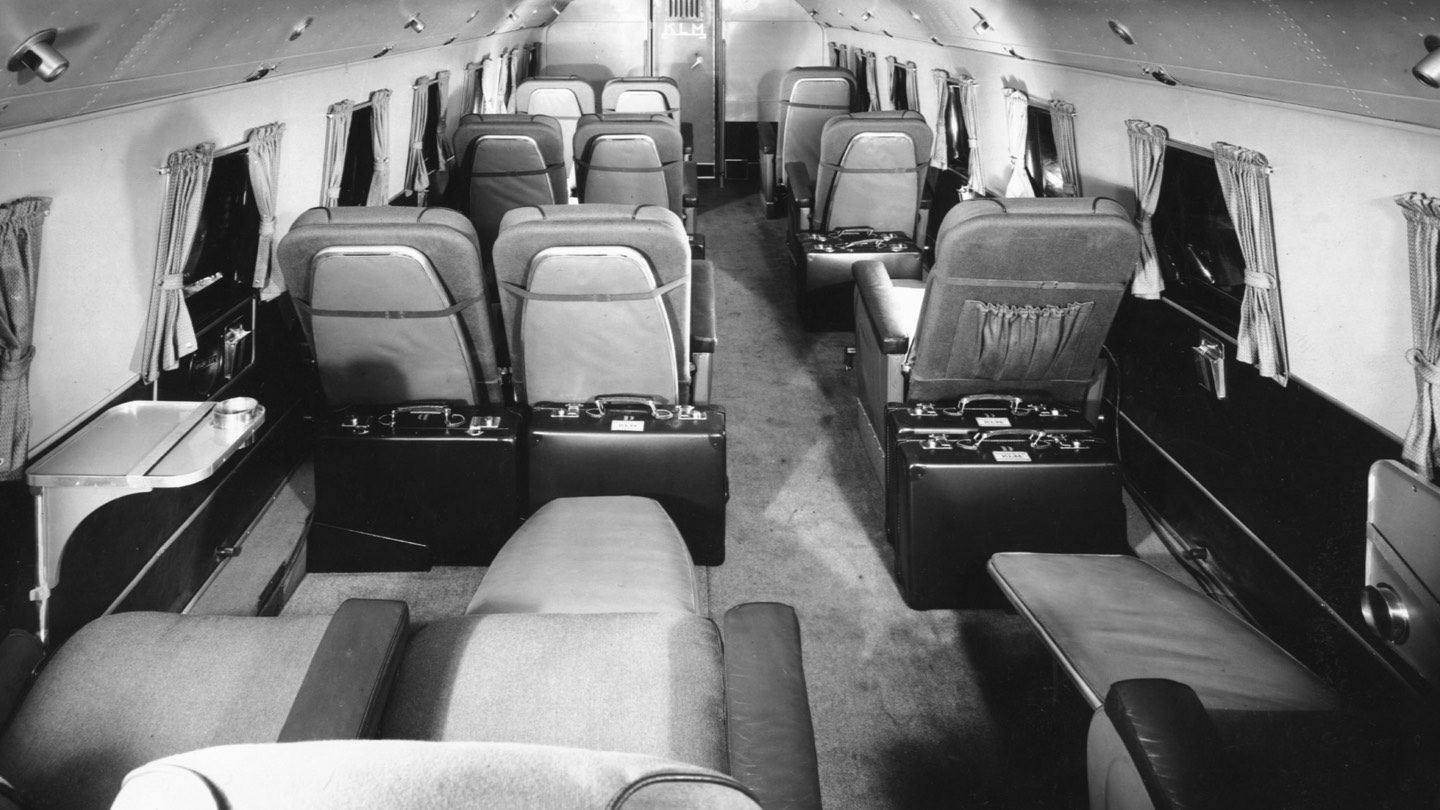
In the 1920s and 1930s, flying was considered a special event – and you could feel that as soon as you entered the cabin. The four-engine Junkers G 38 was transformed into a flying salon: guests could enjoy their time on board in the bar and lounge. There were only eleven seats, some arranged in a double-decker configuration in the fuselage. The seats in the wings which had panoramic views to the front were a special attraction – an exclusive travel experience for a select few.


At the same time, new service standards became accepted. In 1928, male flight attendants – cabin stewards, also called "Luftboys" then – took over regular duties in the cabin for the first time, serving food and drinks to passengers directly at their seats. With the modern Junkers G 31, which was deployed on important Luft Hansa routes, a new level of comfort was introduced: enclosed cabins with upholstered seats, electric lighting and improved noise insulation, plus a lavatory. These benefits offered passengers a previously unprecedented degree of comfort, with features that would only become commonplace much later.

Cozy elegance and Senator Service luxury

The interior design clearly bore the hallmarks of the post-war era: warm, almost salon-like, reminiscent of classic residential and club interiors. At the same time, the colors and symbols of the still nascent Lufthansa corporate identity – blue and yellow, the crane, the characteristic parabola – gradually found their way into the cabin, albeit without a consistently standardized corporate design.


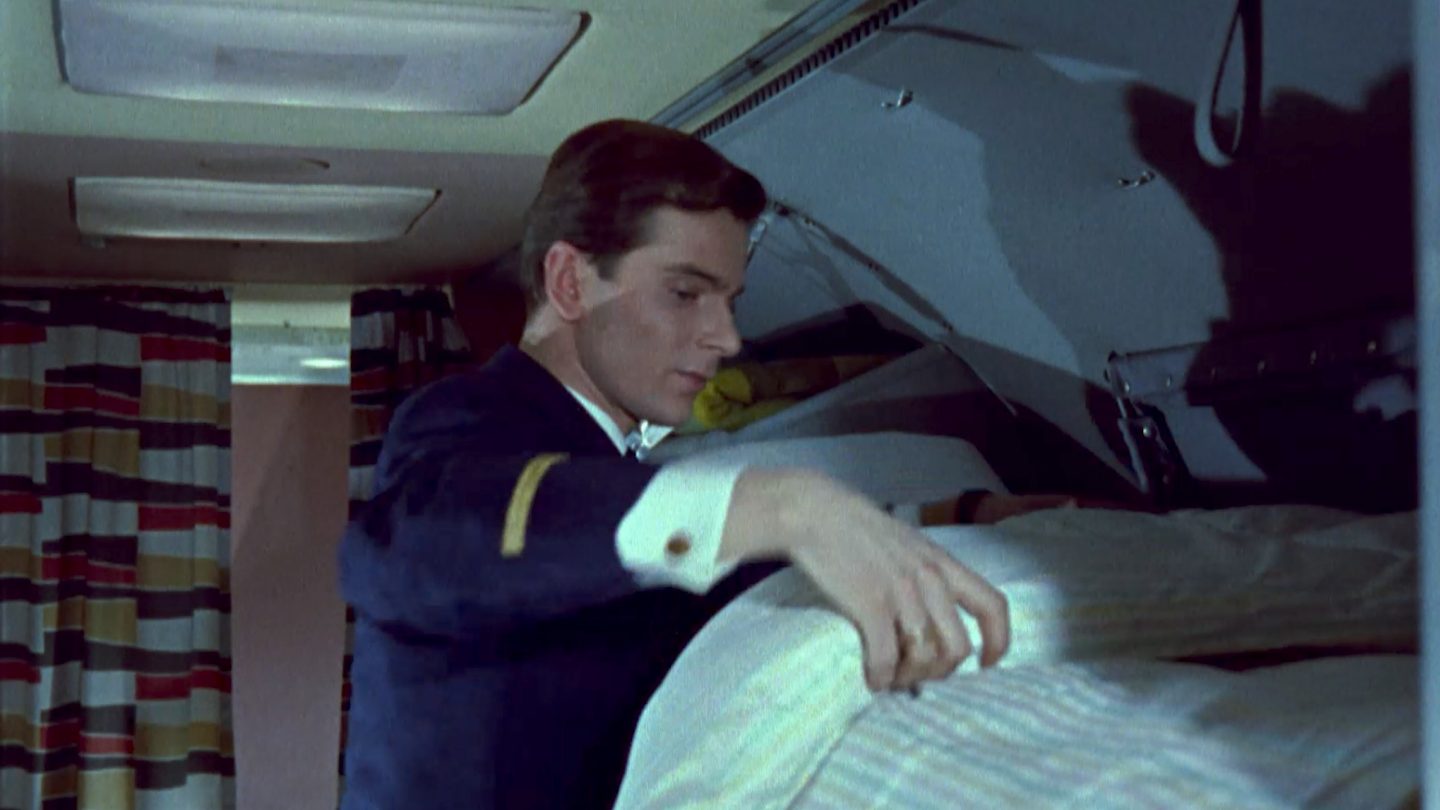
In 1958, a major step followed in the premium segment: Lufthansa introduced "Senator Service" on the Lockheed Super Star. Instead of 86 standard seats, an environment was created that was more reminiscent of a club than a means of transport – flying "as if in a salon". Eight First Class seats, 20 deluxe sleeping seats, four beds and a separate lounge with leather-covered paneling, as well as an onboard restaurant and chef steward, turned the cabin into an exclusive retreat.

The Jet Age and functional modernity
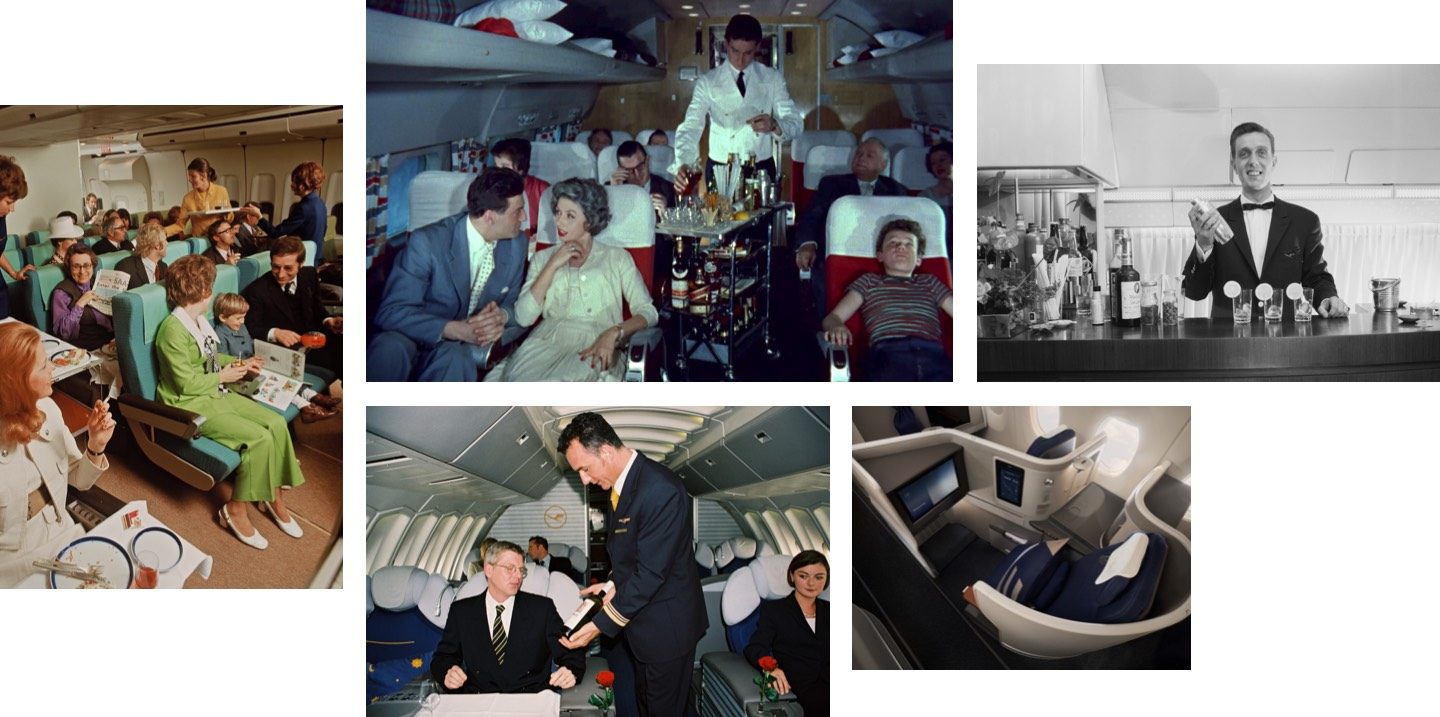
With the introduction of the Boeing 707 at the start of the 1960s, the feel of the Jet Age entered the cabin: a smoother ride, quieter, faster – and with a clearer internal layout. Three seats on each side of the central aisle were now generally used in Economy Class. The cabin appeared more austere and technical, with uniform seat covers in bold colors – such as shades of red with dark accents. While music programs and an extensive in-flight service had been part of the offering on the long-haul fleet since the late 1950s, speed, reliability and efficient service became increasingly central to the overall experience in the 707 era.


The Senator Service was also transferred to the jet fleet. First Class now featured a bar serving cocktails and fine beverages, among other things. Many a guest enjoyed a freshly tapped beer there along with a rustic ham sandwich.

At the same time, graphic designer Otl Aicher, working with the Ulm School of Design, developed an integrated corporate design that, for the first time, also consistently included interior spaces. Corporate colors, typography, signage, and color concepts were defined – thus creating the basis for a Lufthansa cabin that was recognizable worldwide, with consistent design.

“The Queen of the Skies” – new space above the clouds
The introduction of the Boeing 747 from 1970 onwards created a completely new cabin experience. Two aisles, hundreds of seats, an in-flight cinema, and music programs created a previously unheard of travel experience. The iconic spiral staircase to the upper deck led to a First Class lounge where guests could meet for drinks or a game of cards.


Other wide-body jets, such as the McDonnell Douglas DC-10, also opened up new possibilities: larger cabins, wider aisles, clearly zoned service areas. Space itself became a product feature – those who flew with Lufthansa experienced spaciousness, order and structured comfort.
In 1979, for the first time, Lufthansa defined its own color concept for interior fittings: blue, yellow, ochre, orange, brown and olive formed a systematic palette for surfaces, seat covers and paneling. The aim was an interior that conveyed the impression of technical precision, reliability, and quality standards.
The emergence of Business Class
With the new wide-body aircraft of the 1970s, it was not only the cabins that changed, but also the aspirations of travelers. Between the luxurious First Class and the densely packed seats in Economy Class, the need arose for a separate comfort zone for frequent flyers. 1979 was the year Lufthansa Business Class was born.
Inspired by the needs of international business travelers, it combined a larger seat pitch, more space and improved service with a clear product promise: work, rest and arrive in comfort.


Premium on board – service culture and cabin comfort grow together

In the 1980s, the concept of ‘premium’ became even more prominent. First Class cabins on the DC-10 and the Boeing 747 were fitted with comfortable sleeper seats. Long blankets, slippers, and amenity kits made it clear: comfortable sleep and personal relaxation became the central promise on long-haul flights.

At the same time, the choice of entertainment increased; onboard cinema with stereo headphones, a growing selection of newspapers, magazines, and games provided variety on board. Senator Lounges on the ground extended the usual service standard into the airport – thus ensuring a seamless travel experience before, during and after the flight.
The interior design also evolved: at the end of the 1980s, the design agency Zintzmeyer & Lux proposed a new approach to the corporate colors: yellow, as a "discovery color," should set accents, while gray, white and silver emphasized the technical impression – exclusivity, reliability, and quality.

New classes, new comfort
In the 1990s, the cabin was developed systematically. In 1992, Lufthansa upgraded all three travel classes – First Class, Business Class and Economy Class – on the Boeing 747: new seats, improved menus, buffets and modernized in-flight entertainment made each class clearly distinguishable, yet still high-quality.


The Airbus A300 marked the first time a wide-body jet was introduced on domestic German and European routes – a larger cabin, more aisle, and a feeling of spaciousness that until then, had been reserved primarily for intercontinental flights. In the following decades, a new, uniform cabin design developed with the Airbus A319s, A320s and A321s. Overhead bins, lighting, toilets and galley layouts were deliberately standardized so that the travel experience felt more consistent across this aircraft type.
In 1995, the continental fleet received new leather seats manufactured by Keiper RECARO: Business Class and Economy Class were visually and ergonomically upgraded, making the cabins appear neater and more modern.

The big leap forward on long-haul flights followed in 1997: In First Class, guests received new seats that could be converted into beds up to two meters (6.5 feet) long with privacy screens offering significantly more personal space. Comfort also increased in Business Class – with more ergonomic seats, more generous space and seat backs that reclined further for more relaxed working and sleeping. At the same time, the service was further personalized: à la carte menus in First Class, in-flight entertainment with personal screens, as well as improved lounges and arrival services, made it clear that comfort went far beyond just the seat.

Quiet luxury and great entertainment
With the arrival of the 2000s, interior design came more prominently to the fore. Comprehensive corporate design manuals governed architecture and interior design down to the last detail – from materials and color schemes to textiles, china and amenity kits. From 2003 onwards, the long-haul fleet was equipped with personal screens and enhanced entertainment features. Colors, patterns and the crane logo appeared on blankets, pillows, tableware and accessories – Lufthansa design became tangible and perceptible in everyday life in the cabin.


With the Airbus A380, Lufthansa introduced a new First Class in 2010 – with a clearly formulated objective: to create the quietest First Class in the world. An open yet quiet cabin with soundproof curtains, special external insulation, sound absorption in the carpet and air humidification ensured an exceptionally relaxing travel experience. Generous seats that converted into beds of up to 2.07 m (6.5 feet) long and 80 cm (31 inches) wide, plenty of storage space, personal wardrobes and a luxurious bathroom with separate washing and changing areas, completed the premium concept.

Business Class and Economy Class, too, were consistently developed. Business Class retained its two-meter-long (6.5-foot-long) beds and benefited from an improved in-flight entertainment system and additional storage space. In Economy Class, a newly developed, ergonomic seat with a slimmer backrest provided around 5 cm more individual space – especially legroom. From 2012 onwards, further modernizations in service and equipment followed across all classes: new Business Class seats, the introduction of Premium Economy Class, reimagined amenity kits, upgraded lounges and an expanded entertainment offering.

Customized comfort – from Airspace to Allegris
Since the 2020s, the focus on board has strongly shifted towards comfort, digitalization and individuality. The Airbus Airspace cabin is used in aircraft of the A320neo family: 40% larger overhead bins, ergonomically shaped side panels with more shoulder room, Human Centric Lighting and more modern, more easily accessible washrooms noticeably change the feeling of space on continental routes.
Since 2023, our A320 and A321 aircraft have been gradually retrofitted with new cabins. These cabins feature large overhead compartments that can hold up to twice as much carry-on baggage as well as USB ports at every seat, smartphone and tablet holders and more legroom thanks to ergonomically shaped backrests. This brings a level of comfort on short- and medium-haul routes that was previously only available on long-haul routes.
