

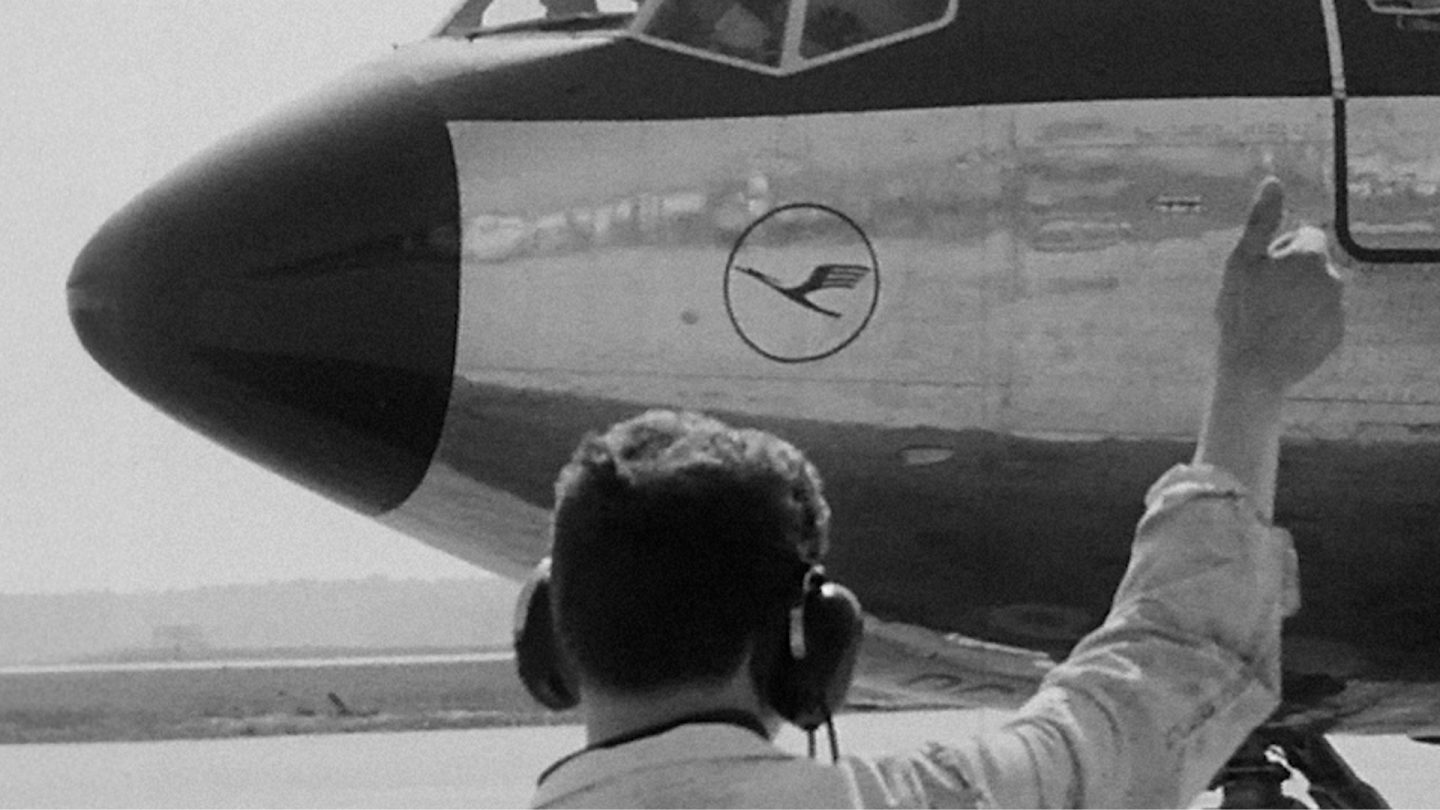

100 years under the symbol of the crane – a century of Lufthansa. Join us on an eventful journey of pioneering spirit, disruptions, and new beginnings. What began in 1926 and relaunched in the 1950s, is today a global success story. Experience the pivotal moments and learn how Lufthansa has reinvented itself time and again in the face of political and historical barriers so that today, it takes millions of people to their destinations year after year.
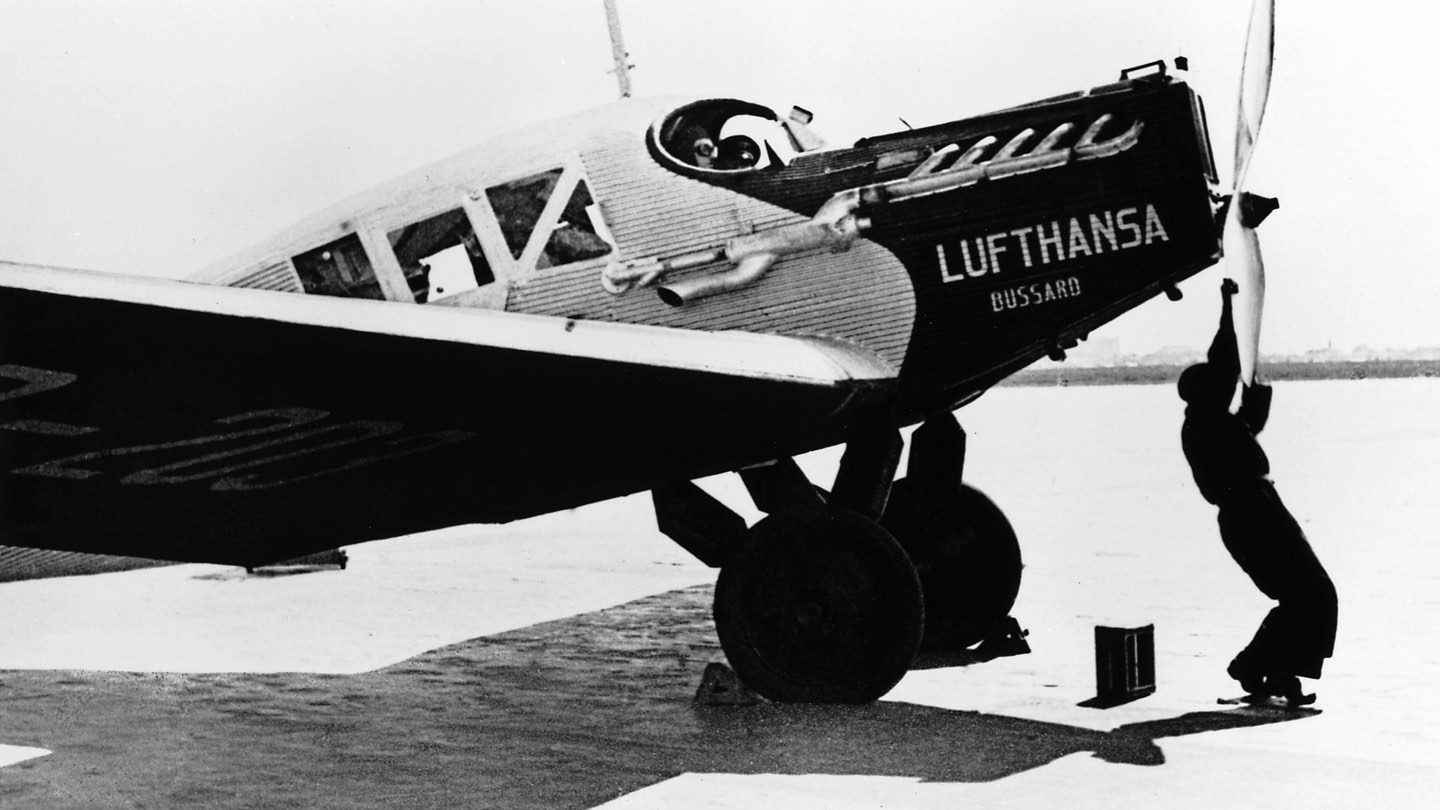

A historic moment for German aviation: In Berlin on January 6, 1926, Deutscher Aero Lloyd AG (DAL) and Junkers Luftverkehr AG (ILAG) merge to form Deutsche Luft Hansa AG (DLH). With the crane as their new logo, the first aircraft take off in the spring, heralding a new era in the skies.

1927
One year after its founding, Luft Hansa has a remarkable route network: The crane flies from Munich over the Alps to Venice and from Berlin over the Baltic Sea to Oslo, as well as offering a regular connection to Moscow.
In the same year, Luft Hansa tests the combination of air and rail travel for the first time. Linking the two modes of transport enables shorter travel times and better regional connections – the foundation for Lufthansa Express Rail.

1929
On May 29, Luft Hansa ushers in a new era of summer vacations and launches regular ‘bathing routes’ to island destinations such as Sylt, Norderney, and Rügen. Flying boats such as the Dornier Wal drastically reduce travel time to the coast and even make the arrival itself into an event for beachgoers. The new service is promoted with the iconic campaign "Fliegt in die Bäder!” (Fly to the seaside).
1932
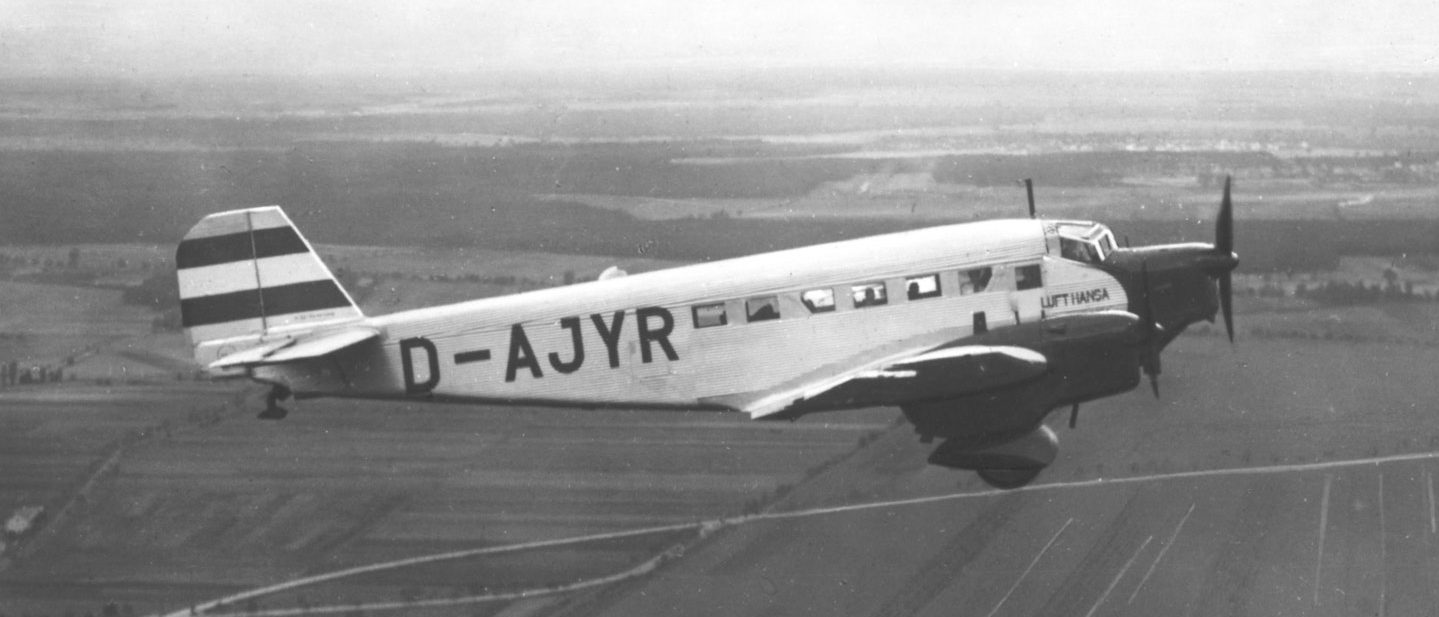
The first Junkers Ju 52 is added to the Luft Hansa fleet. The legendary aircraft, soon affectionately nicknamed "Tante Ju” (“Aunt Ju"), becomes the airline's "workhorse" and has since been a symbol of pioneering spirit and engineering excellence.
1933
With the rise to power of the National Socialists, Luft Hansa enters a phase of political appropriation and enforced conformity known as ‘Nazification’. One of the first changes: at the annual general meeting, the decision is taken to reformulate the company name to make Luft Hansa one word: Deutsche Lufthansa Aktiengesellschaft.
1934
Lufthansa establishes a regular airmail service to South America. The route is long, the fuel tank too small, but a solution is found: The aircraft land in the middle of the Atlantic, are refueled on a ship and then take off again – a logistical tour de force.

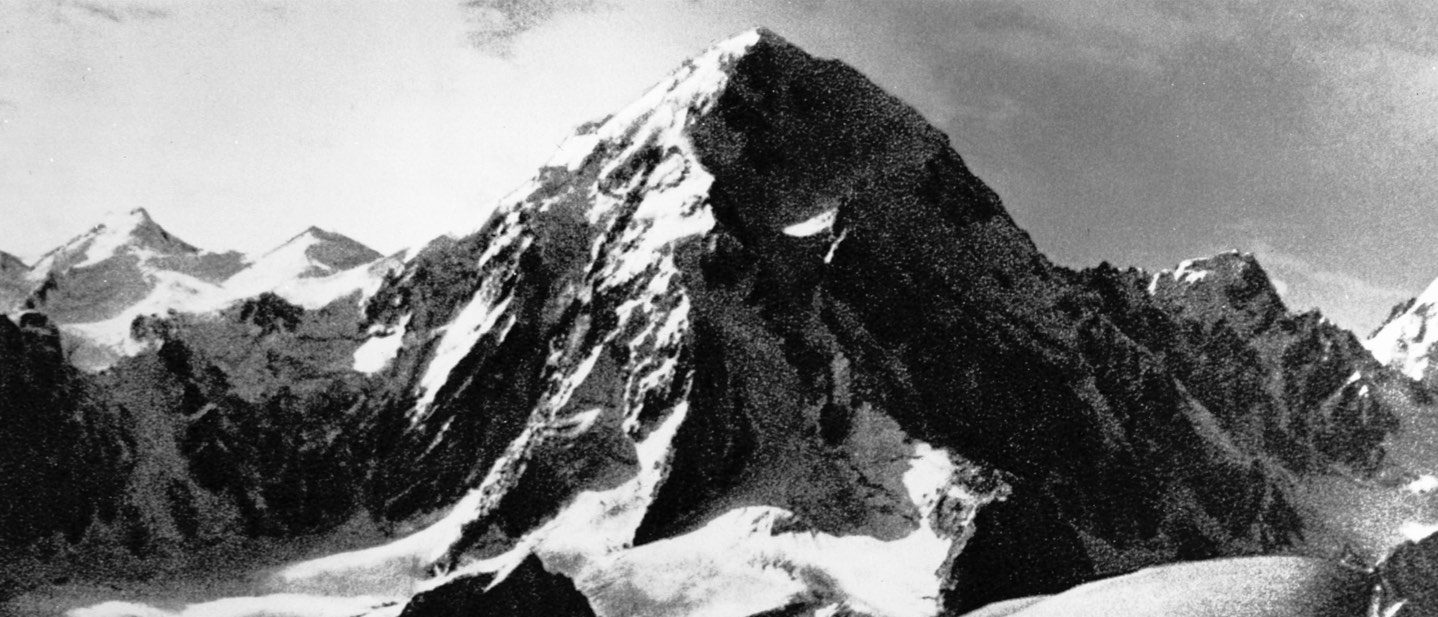
Lufthansa takes off from Berlin with two Junkers Ju 52s for an expedition to the Pamir Mountains in Central Asia – one of the most remote and dangerous regions of the world. The aim is to test potential aviation routes to the Far East and to open a route that does not pass over Soviet territories. What makes this expedition special is that the aircraft must fly over passes more than 5,000 meters (16,400 ft) high, navigate through narrow mountain gorges, and cope with extremely unpredictable weather conditions.
One of the Ju 52s has to make an emergency landing in Hotan in northwest China. The crew is temporarily detained there and can only return safely to Berlin after several weeks in captivity.
1938
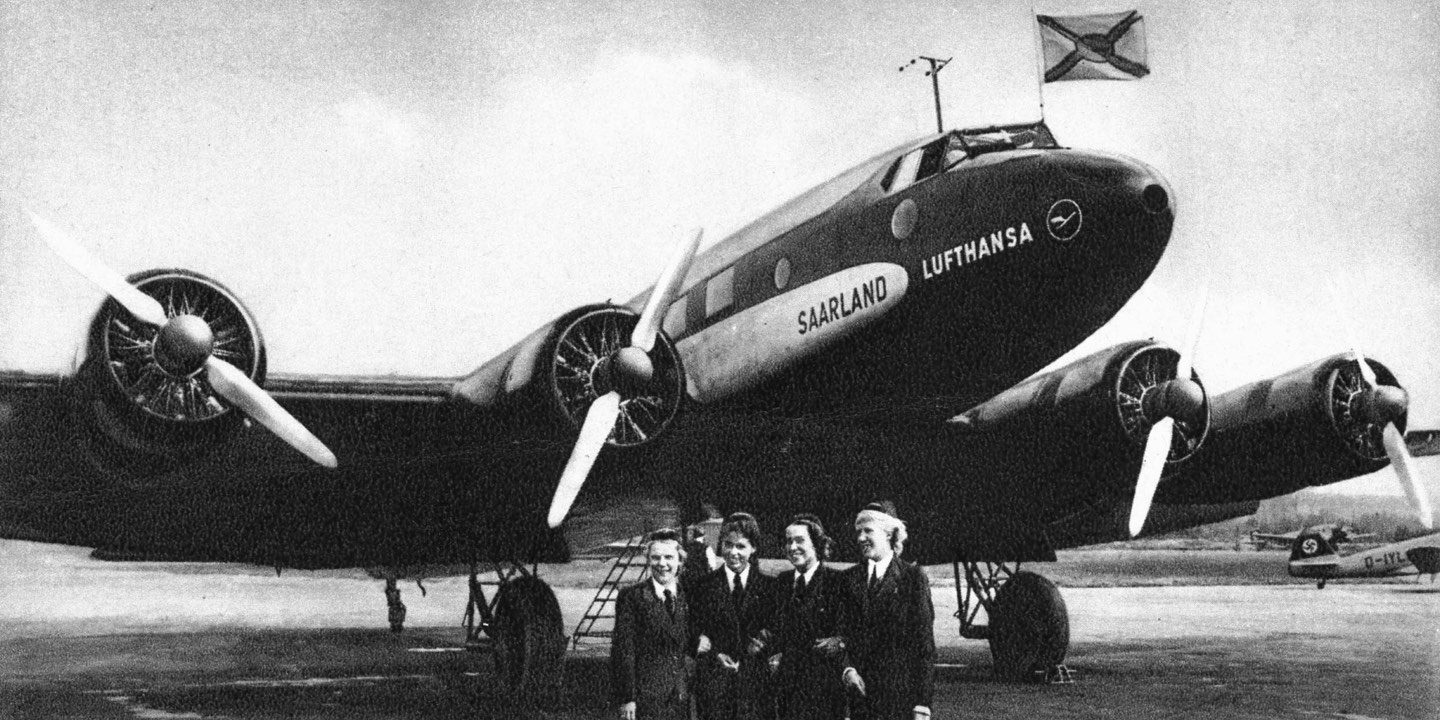


1939
The Second World War begins with the German invasion of Poland on September 1, 1939. Scheduled air traffic almost completely comes to a halt. Many aircraft and crews are transferred to the Luftwaffe.
1945
After the war ends, the Allies prohibit Germany from any form of flight operations. The manufacture, possession, and use of aircraft is forbidden, and German aviation comes to a complete standstill.
1933-1945
Lufthansa during National Socialism
The seizure of power by the National Socialists in Germany in 1933 saw the start of the darkest chapter in the history not only of the country but also of Lufthansa.
The first Lufthansa became part of the Nazi regime and participated in its military and criminal activities. Not everyone in the company, albeit far too many, actively supported this course of action. Before and during the Nazi era, Lufthansa profited from state subsidies and collaboration with leading National Socialists among other things. During the Second World War, the company trained pilots for the Luftwaffe and was involved in the production of munitions. Thousands of forced laborers, comprising up to 50 percent of the workforce during certain periods, were put to work under conditions that were both discriminatory and inhumane.
Lufthansa is also using the centenary of its founding as the opportunity to re-examine the company’s responsibility during the period of National Socialism. Insights into the role of Lufthansa during the Nazi era feature in the book Lufthansa – The First 100 YearsThe link will be opened in a new browser tab, written by three independent economic historians. In summer 2026 a new visitor center, Hangar One, will open at Frankfurt Airport showing displays concerning the Nazi period, among other exhibitions.

1951
A year characterized by important decisions for the re-establishment of Lufthansa. While the first Lufthansa is liquidated in February 1951, specific planning for the fresh start begins in Cologne. Commissioned by Transport Minister Hans-Christoph Seebohm, a team led by Hans M. Bongers develops the foundations for a new German airline this same year. This project is facilitated by the Allied commitment to the gradual return of West German air sovereignty.
1953
Germany is rebuilding, and aviation, too, is seeking a new beginning. The green light for this is given in Cologne: With the establishment of the "Aktiengesellschaft für Luftverkehrsbedarf" (Luftag), the foundation for the second Lufthansa is laid.
1954
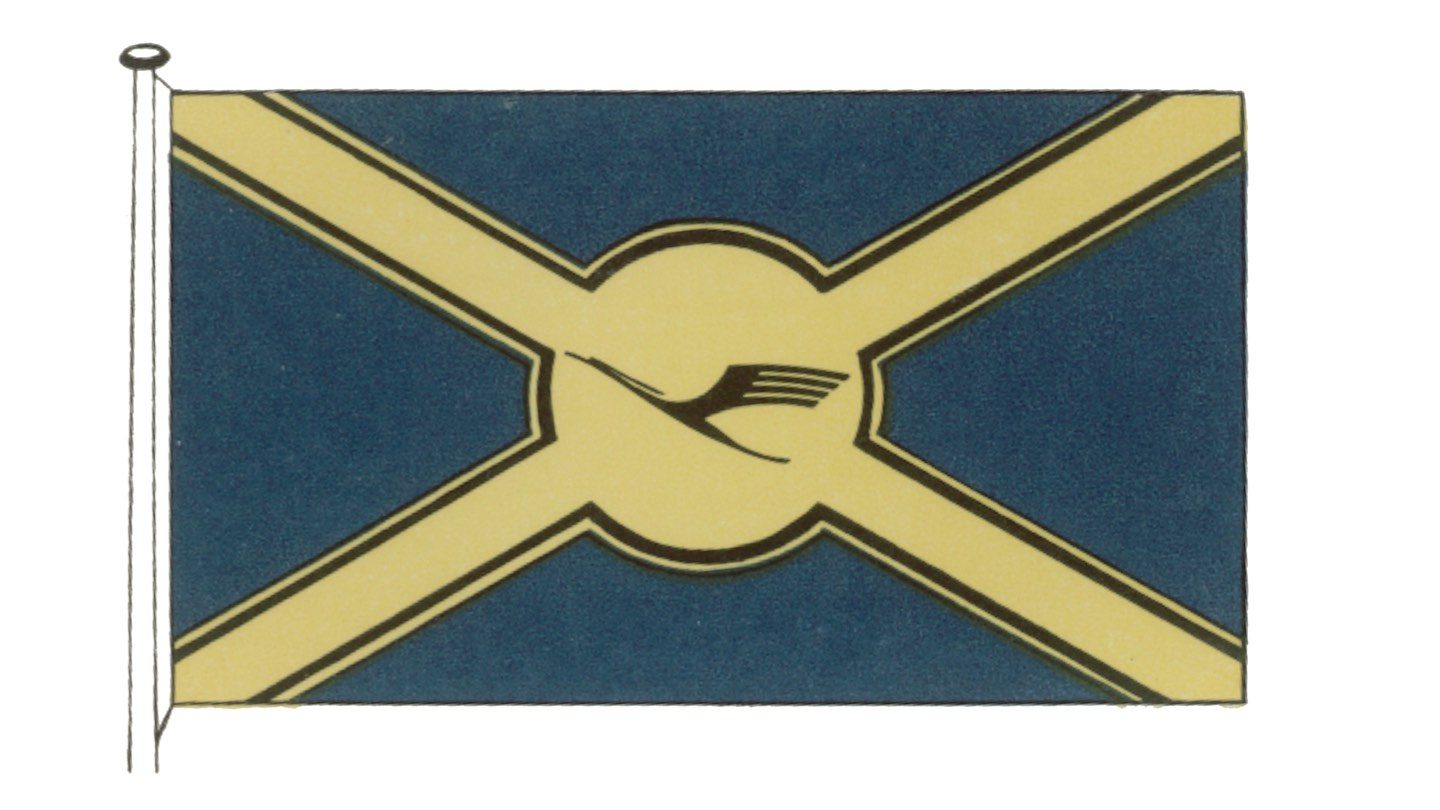
On August 6, the annual general meeting of the Aktiengesellschaft für Luftverkehrsbedarf (Luftag) decides to adopt the traditional name of Deutsche Lufthansa AG. A few weeks later, the company also pays 30,000 Deutschmarks to secure the rights to the historic symbols of the first Lufthansa: The crane and the blue and yellow flag thus officially return as trademarks of the new West German airline. This ensures that the newly founded company maintains visual and name continuity with the pre-war airline, even though it is legally a new company.


Lufthansa develops a new corporate design – the crane is given a consistent form and becomes the symbol of a new era. In the same year, the young airline finally takes to the skies. Two Lufthansa Convair 340 aircraft, bearing the German national insignia on their tails, take off almost simultaneously on April 1. One aircraft, flies from Hamburg towards Munich – with stopovers in Düsseldorf and Frankfurt. At the same time, a Convair departs from Munich, heading towards Hamburg via Frankfurt and Cologne.
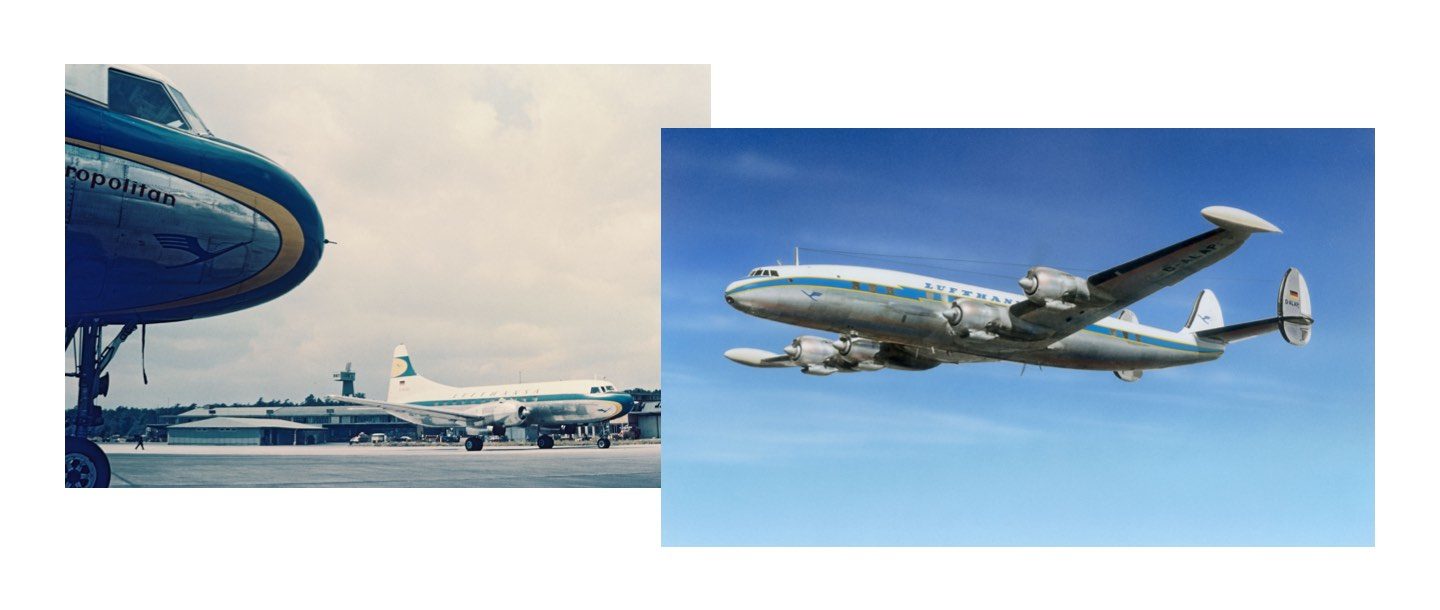
On April 19, 1955, the first Lockheed Super Constellation is delivered to Lufthansa. Shortly afterwards, the crane “crosses the pond” – the first transatlantic flight by the second Lufthansa takes off from Hamburg to New York on June 8. At the same time, Lufthansa is undertaking special missions on behalf of sports and politics: The West German national athletics team travels to Helsinki on a special flight. In addition, two Lufthansa aircraft take Chancellor Konrad Adenauer and a West German delegation to Moscow-Vnukovo Airport.

1956
Lufthansa opens its first South American route – from Hamburg via Düsseldorf/Frankfurt, Paris and Dakar to Rio de Janeiro, São Paulo, and Buenos Aires. Thousands of kilometers, multiple time zones – a massive leap that connects continents and significantly expands the international route network. Scheduled flights to Tehran, Istanbul, Beirut, and Baghdad are also added.
Lufthansa launches its "Paper Jet" project, developing an innovative simulation program. Long before the first real jet takes off, all processes, routes and conditions of future jet traffic are simulated on paper – a forward-looking concept that enables the airline to prepare early and precisely for the coming Jet Age.

A new star in the sky heralds a new era – the Lockheed L-1649A Starliner. The "Super Star" is considered the new “carrying card” of transatlantic air travel and, at this time, is the most modern large-body aircraft in the world. The new aircraft brings more comfort, greater range, and more reliability – a major upgrade for transatlantic air travel. In the same year, Lufthansa welcomes its millionth passenger since it resumed flight operations in 1955. An early testament to the great trust passengers have for the airline.


Shortly thereafter, Lufthansa introduces its exclusive Senator Service in First Class on the New York route for the first time. This service offers 18 deluxe sleeper seats, beds, a lounge, and exquisite catering with the aim of attracting wealthy customers.

1964
With the arrival of the Boeing 727, Lufthansa's modern European jet takes off for the first time. This three-engine aircraft heralds the transition to the Jet Age on short- and medium-haul routes, too, and significantly changes flying within Europe.

On July 23, a baby is born at an altitude of 10,000 meters (33,000 ft) for the first time in history on a Lufthansa flight from Frankfurt to New York. The girl is named Barbara Lufthansa Herzog.
1968
In previous years, Lufthansa had already convinced the US manufacturer Boeing to design a jet that could operate economically over short distances. Lufthansa engineers introduce their specific requirements directly into the construction phase – a first in the company's history. The result of this close collaboration is the Boeing 737, aptly named City Jet by Lufthansa, which becomes one of the most successful aircraft families in aviation history.
Lufthansa is the first customer in the world to put the City Jet into scheduled service, now bringing the Jet Age into everyday travel.
1970
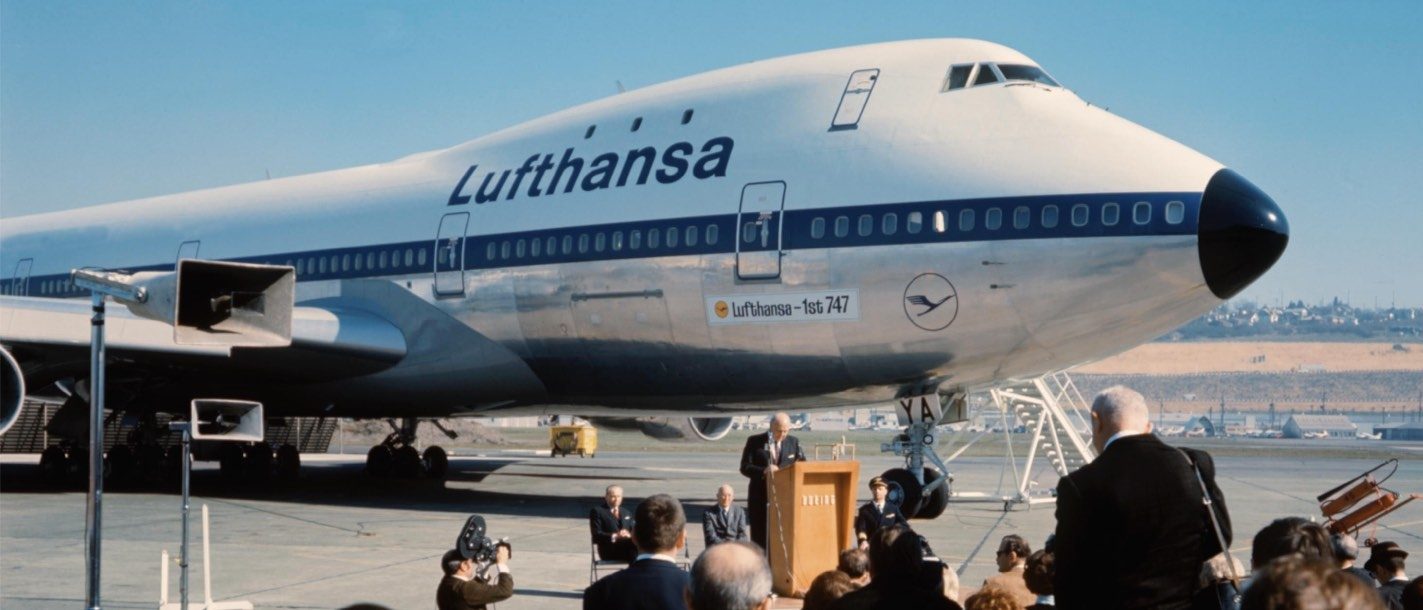
The first deployment of the Boeing 747 in April on the Frankfurt–New York route marks the beginning of the Jumbo era for Lufthansa on the North Atlantic route. The so-called Jumbo Jet, also known as the “Queen of the Skies” because of its elegance and size, offers 32 seats in First Class and 333 in Economy in its initial configuration for Lufthansa. In addition, there are two aisles, an onboard cinema, and a lounge on the upper deck – a completely new experience in terms of space and comfort for long-haul passengers.

1972
The Jumbo Jet is not just an advantage for passengers. Lufthansa recognizes its potential for cargo transport early on and in 1972 becomes the first airline in the world to deploy the freighter version of the Boeing 747. A characteristic feature of this freighter is the swing-up nose door, which facilitates the loading of bulky goods.
1973
The first oil crisis and the sharp rise in kerosene prices force Lufthansa to reduce its services, implement savings programs, and take rationalization measures, without an immediate recovery in route results. Nevertheless, Lufthansa is considered relatively robust compared to many international competitors and is able to increase its passenger numbers further over the decade.

With the introduction of the Douglas DC-10 from January, Lufthansa acquires another wide-body jet. The three-engine aircraft will primarily take over the long routes to the Far East and South America, for which the Jumbo Jet is sometimes too large, or the range of the smaller jets is insufficient.
The company is also significantly involved in the Airbus consortium and contributes its expertise to the development of the Airbus A300.

1977
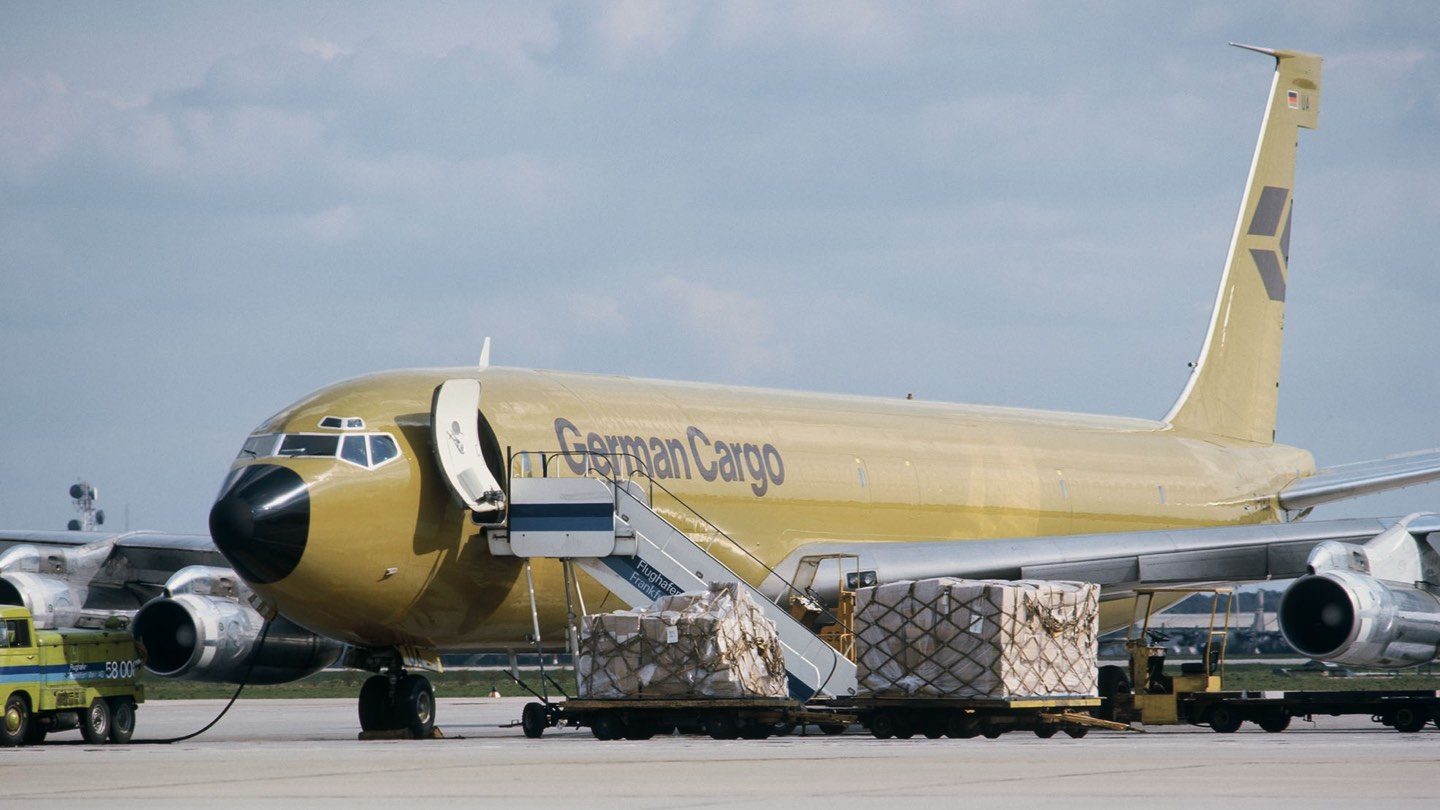
With the formation of German Cargo Services GmbH, Lufthansa opens a new chapter. Through its own, legally independent charter subsidiary, the airline can operate more flexibly and cost-effectively. German Cargo rapidly becomes expert in handling anything that is bulky, delicate, or alive. Whether racehorses, day-old chicks, or complete industrial plants – anything that doesn't fit in the cargo hold of a scheduled airliner is taken care of by the charter subsidiary.
During the “German Autumn” terrorism crisis, Lufthansa flight LH 181 becomes the setting for an attack. On October 13, terrorists hijack the Boeing 737 Landshut. After a disastrous flight and the murder of Captain Jürgen Schumann in Aden, the hostage drama ends at Mogadishu Airport. The rescue by West German counter-terrorism unit GSG 9 on October 18 saves all 86 passengers – a dramatic milestone in German aviation history.

1979
A small revolution takes place in the cabin: For the first time, female flight attendants are officially allowed to wear trousers as part of their uniform. Lufthansa is thus adapting to societal changes and proving once again that tradition and progress can go hand in hand.

After a 51-year hiatus, Lufthansa resumes regular flights to “The Middle Kingdom”. On April 7, a McDonnell Douglas DC-10 takes off from Frankfurt on the first scheduled flight to Beijing.
In the fall, a Lufthansa crew is accorded a special honor. At the conclusion of his first major visit to West Germany, Pope John Paul II chooses the airline for his return journey to Rome.

1983
The first Airbus A310-200 lands in Frankfurt on March 29. Lufthansa, as the "launching customer," played a key role in the aircraft's design.
1986
Evi Lausmann and Nicola Lunemann are the first two women to begin their training as commercial airline pilots with Lufthansa. They are paving the way for many more female pilots. In August 1988, they flew their first scheduled flights as first officers (co-pilots) on a Boeing 737. However, in the first few years, there is no separate uniform for female pilots. They wear men's uniforms, including ties and men's caps, essentially "dressed as men" in order – as it is said internally – not to unsettle the passengers.


Michele Jett is the first woman to start work as a flight engineer in a Lufthansa cockpit on a Boeing B727 – many more women in the cockpit will follow.

1988
In June, a radical redesign of the corporate identity is presented. The proposal to emphasize the color yellow much more strongly (even with a yellow fuselage and tail) leads to a trial paint job on a Boeing 737-200. However, the design is rejected by the public and employees as resembling a flying canary and is withdrawn after fierce protests.
1989
A new era of long-haul travel begins when the first Boeing B747-400 arrives at Frankfurt Airport. With its size, range, and modern technology, it sets new standards.

The Boeing 747-400 with the registration number D-ABVE is christened "Potsdam" in September 1990, just a few days before German reunification. A deliberate gesture to carry the name of a city from the former GDR out into the world.
The day before official reunification, Lufthansa carries out a historic special flight. An Airbus A310 takes off from Cologne/Bonn with around 100 members of the Bundestag on board and lands at Berlin-Tegel. This means that Lufthansa is officially back in Berlin after a 45-year hiatus and it resumes scheduled services from October 28.

Travel between East and West Germany quickly returns to normal. Lufthansa contributes to this by opening many new routes – the experience of flying will become the symbol of a new freedom for millions of people.
1992
With the end of the Cold War and the opening up of the global economy, Lufthansa greatly expands its route network. In the 1992 winter flight schedule, Cape Town, Windhoek, and Almaty are served directly for the first time, underscoring the growing importance of new international markets.
1993
With Miles & More, Lufthansa introduces Germany's most important frequent flyer program. Passengers are able to earn miles and redeem them for upgrades, free flights, or lounge access – the beginning of a modern customer loyalty scheme in German air travel.
The Airbus A340 replaces the older DC-10 and B747-200. It features a quieter, more modern cabin, improving comfort in Economy Class and Business Class on long-haul flights.
First Class is phased out on intra-European routes. As part of a new service concept, often referred to as the "Europe Concept," Lufthansa converts its cabin on short- and medium-haul flights into a two-class system. At the same time, Business Class is significantly upgraded. It will become the new premium product on continental flights.

The Airbus A319 complements the successful A320 family as a slightly smaller variant and becomes an integral part of European air traffic.


1997
The Star Alliance is founded in Frankfurt. Lufthansa launches this first global airline alliance together with United Airlines, Air Canada, SAS, and Thai Airways. It leads to a massive expansion of the service offering. Passengers benefit from shared lounges and a consistent travel experience across the global network, which now serves more than 578 cities in over 106 countries with over 1,334 aircraft.
Lufthansa becomes a wholly privately owned company. This increases the pressure to operate profitably but also allows for more flexible investments in new products and cabin equipment, enabling the airline to remain competitive internationally.


In the same year, a comprehensive redesign in a modern retro futuristic style is introduced. Silver accents, subtle echoes of the legendary Ju 52 and an iconic, contemporary look is infused into the entire Lufthansa corporate identity – from the aircraft, the magazines, and the cabins to the on-board cutlery.

As part of its "Future Cont." project, Lufthansa introduces a series of noticeable improvements for passengers. In Business Class, the middle seats will remain empty, creating greater privacy, elbow room, and space to relax. At the same time, the in-flight service on European routes gets a modern update – rounded off by new, elegantly designed tableware.
Passengers are now connected even during a flight. Lufthansa FlyNet® is used for the first time in routine operation on a flight from Munich to Los Angeles. Lufthansa is therefore the first airline in the world to offer passengers fast Internet access above the clouds.


In the same year, the Lufthansa First Class Terminal and two new First Class Lounges open at Frankfurt Airport. Here, First Class guests and HON Circle Members enjoy the highest standard of service – with individual attention and an atmosphere that makes every journey special.
2005
A new chapter in aviation begins. In Toulouse, the world's largest passenger aircraft is presented to the public with the rollout of the Airbus A380. Shortly afterwards, the Airbus A380 has its premiere in Frankfurt. Three years before its planned introduction, an aircraft with the serial number 004 lands as part of a test flight for the first time at an international airport – the Lufthansa hub in Frankfurt.

2006
The retrofitting of the Lufthansa continental fleet with the new Economy Class seats begins. The high-quality leather seats in a subtle color scheme give the entire cabin a new and modern look. The new seats also weigh less, leading to a reduction in fuel consumption.
The 18th FIFA World Cup is held in Germany. Fifty aircraft from the Lufthansa fleet are painted with the “football nose”. They are carrying the World Cup team from Germany to the rest of the world.
2008
The Lufthansa app is introduced, marking the start of Lufthansa’s mobile offering. Since then, it has undergone several technical and design revisions, including a completely redesigned version – the digital travel companion – from 2023 onwards.

A giant lands in Frankfurt. Lufthansa receives its first Airbus A380 – the world's largest passenger aircraft. On the same day, the A380-800, registered with the call sign D-AIMA, is christened “Frankfurt am Main” by Frankfurt's mayor Petra Roth. The new Lufthansa First Class also celebrates its world premiere on board the aircraft. Its luxurious seats can be converted into beds 207 cm long and 80 cm wide (81.5 in x 31.5 in).

2011
Lufthansa takes a step towards the future by being the first airline in the world to test biofuel in daily scheduled operations. A specially selected Airbus A321 shuttles between Frankfurt and Hamburg for six months for this purpose. A test phase that demonstrates how the search for new, more sustainable ways of flying is being driven forward.
2012
Lufthansa is the first airline in the world to take delivery of a Boeing 747-8 Intercontinental. The new generation of the legendary Jumbo Jet is quieter, more fuel-efficient, and more comfortable than its predecessor model.
In the same year, after a construction period of approximately four years, Concourse A-Plus at Frankfurt Airport opens as scheduled. The 800-meter/2,625 ft-long western extension of Terminal 1 will predominantly be used by Lufthansa and its Star Alliance partners.

2016
The new satellite terminal opens at Munich Airport – a modern hub that impresses with short distances to gates and an improved travel experience. Another milestone for the Lufthansa hub in Munich.

For the Olympic Games in Rio de Janeiro, Lufthansa carries German athletes and their equipment to Brazil – a special service in the name of sport.
In Hamburg, in the same year, Lufthansa takes delivery of its first A350-900. The twin-engine long-haul aircraft consists largely of innovative composite materials and is the most modern and environmentally friendly aircraft on the market. For Lufthansa, this means entering the so-called “2-liter class” – with a consumption of around two liters of fuel per passenger, per 100 kilometers flown.

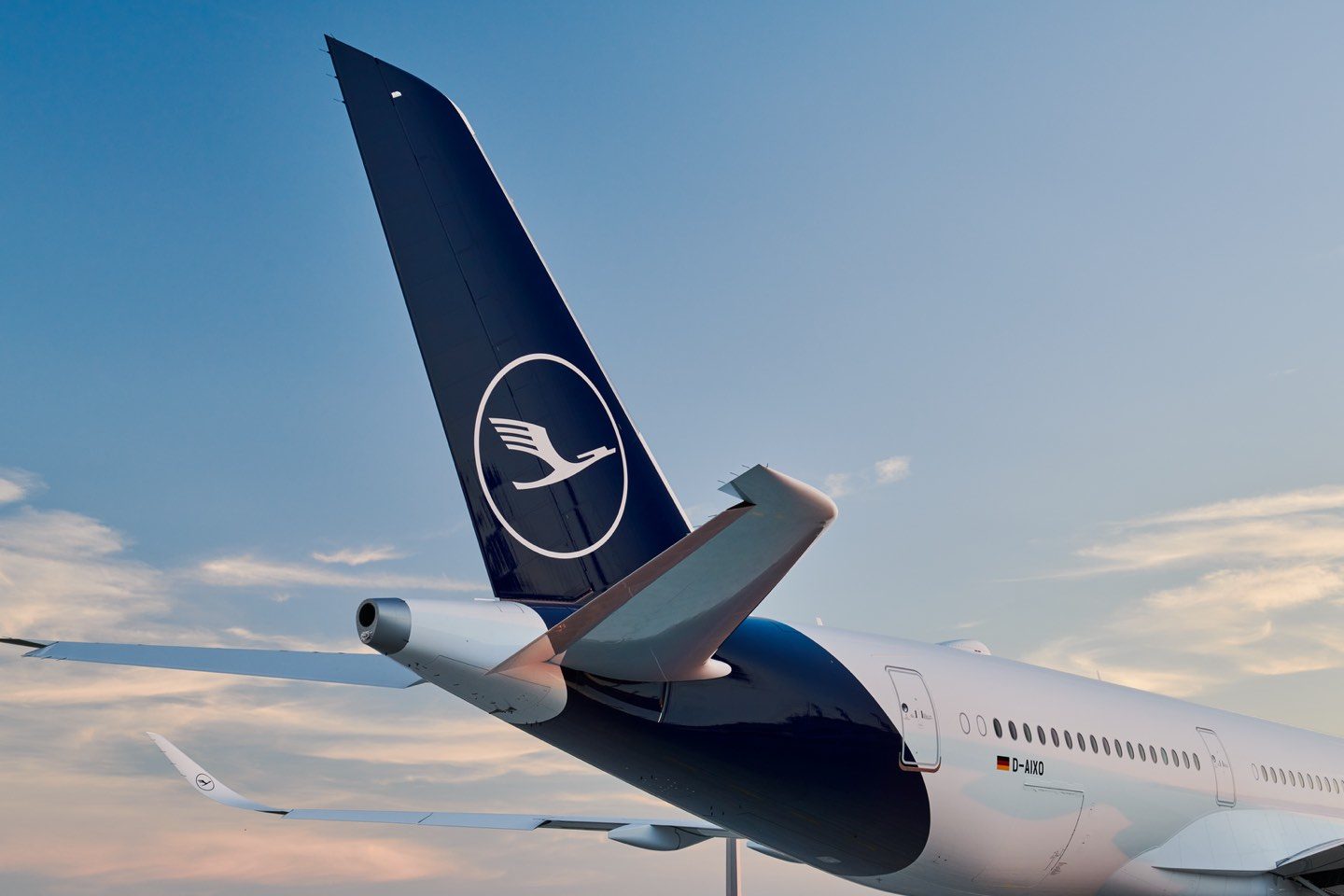
Frankfurt and Munich are the settings for a special moment. Lufthansa presents its updated brand identity at two major events – and with it, a fleet with a fresh new look. The classic yellow disappears from the tail fin, and a sophisticated dark blue becomes the dominant brand color.
2020
In March, the global Covid pandemic brings the world to a standstill. Where thousands of people used to fly around the world every day, an eerie silence now reigns. The majority of the Lufthansa fleet must remain grounded – parked on runways and taxiways, carefully preserved and mothballed by the engineers. Cancelled flights, repatriation flights, mandatory mask wearing. Lufthansa responds to the pandemic with completely new service concepts such as flexible rebooking rules, new hygiene standards, and contactless processes at airports.

2022
After the crisis comes a new dawn – symbolized by the arrival of a new type of aircraft that redefines efficiency and comfort. On August 30, the first Boeing 787-9, the so-called “Dreamliner”, lands in Frankfurt. In the same year, Lufthansa flies the German team to the Olympic Games in Beijing, China, on special flights, while Lufthansa Cargo takes care of the sports baggage – a joint mission for the Olympic moment.

Lufthansa launches the biggest product campaign in its history. Under the name “Lufthansa Allegris”, the travel experience in all classes is completely reimagined. At the heart of the renewal is the move away from the one-size-fits-all approach. In Business Class alone, passengers can now choose between a number of different seating options – from the suite with extra privacy to the extra-long bed seat that extends to 2.20 meters (over 7 ft) in length. Flying becomes more personal, relaxed, and comfortable than ever before.


2025
The new Lufthansa Allegris cabin is available on an increasing number of flights: from Munich, destinations include New York, Chicago, Miami, Shanghai, and Cape Town. In addition, passengers are able to experience Lufthansa Allegris on the new Dreamliners departing from Frankfurt.

2026
Together we are celebrating 100 years of Lufthansa and looking to the future full of anticipation.
The first 100 years of Lufthansa – the book about the history of a global brand
The impressively illustrated volume presents the first comprehensive account of the hundred-year history of Lufthansa – from the pioneering days of 1926 and the airline’s role during the Nazi period to its relaunch after the war and its rise as a global player in aviation.
Based on newly available sources, archive material, and rare photographs, the book offers profound historical insights and shows how technology, vision and global ambition have shaped the airline.
