

A Career with Many Facets at 35,000 Feet: How Do You Become a Flight Attendant?
Flight attendant Marie Hecker shares what it takes to pursue a career 35,000 feet above the ground, reflects on her experience navigating the application process, and explains why, even after 14 years on the job, she still can't imagine a better career
The chance to travel the world and see places you might never visit on your own is what draws many aspiring flight attendants to the job. I have to admit, though, that I had never seriously considered it myself. After graduating from high school, I asked friends and family what kind of career they could picture me pursuing. Then one friend said, "I know two people who are flight attendants at Lufthansa – you'd be a great fit." Without expecting too much to come of it, I submitted an application to Germany's largest airline.
What I didn’t know at the time was that becoming a flight attendant at Lufthansa is not something that happens overnight. The job comes with a specific set of requirements – from strong German and English skills and a height between 1.55 and 1.95 meters (between 5'1" and 6'5") to solid general knowledge of the world. Just as important are the soft skills: a high degree of flexibility, openness and ability to adapt to constantly changing crews, people, and situations – and above all, perseverance. Crew members can sometimes be awake for up to 30 hours at a time, as working days can be long and demanding. Young and optimistic, I was confident that my experience working in hospitality during my school years had prepared me to meet those requirements.
Then the application process began: an online application, an English test, and finally an invitation to the assessment center in Frankfurt. The most exciting part was the psychological evaluation, designed to determine whether candidates were suited to the responsibility of carrying out duties in the cabin. This was followed by the medical assessment and a background check conducted by the aviation security authorities.
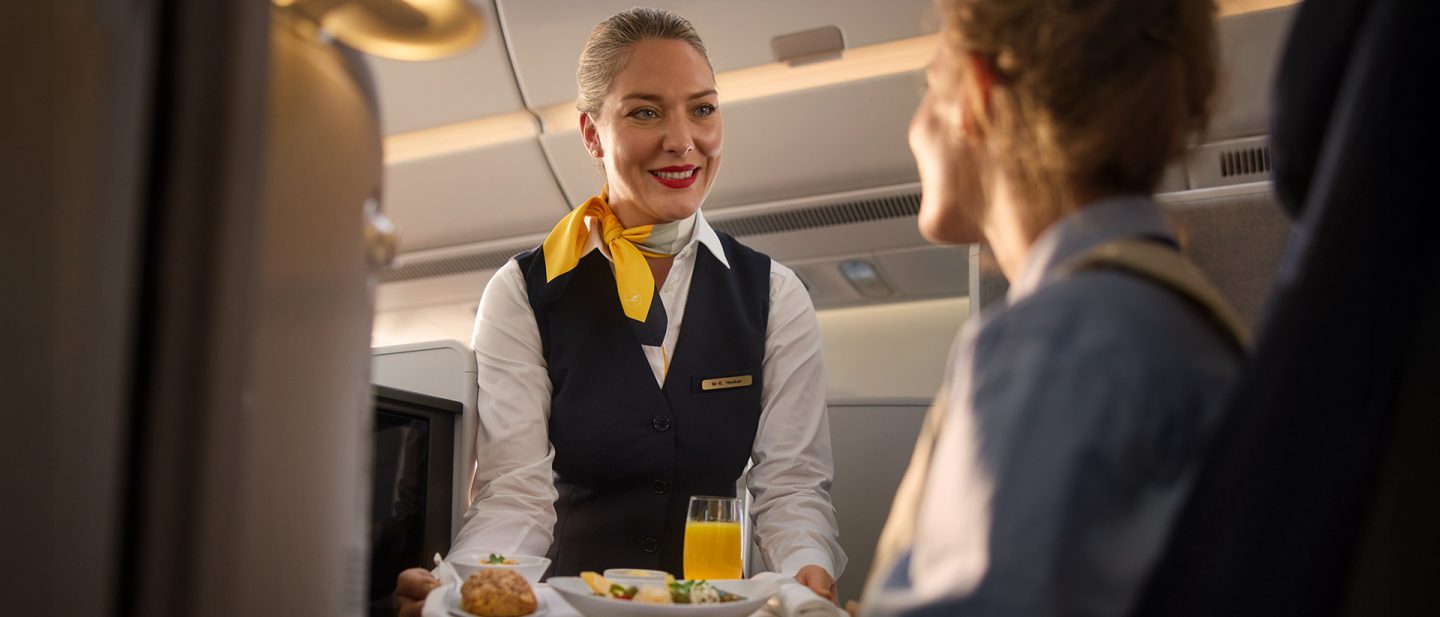
I received a job offer, and a few months later I began my training at Lufthansa Aviation Training in Schwaig, Bavaria. Unlike many other professional training programs, the theoretical portion of flight attendant training is considerably shorter and more intensive, lasting just three months. Divided into two sections, the first part focused entirely on onboard service – something that came naturally to me.
The second part was entirely new to me – and far more demanding. In the emergency training module, we learned how to handle safety procedures and a wide range of potential emergency situations. The evacuation drills in the aircraft mockup were both thrilling and challenging: we learned how to evacuate an entire aircraft within 90 seconds.
Our instructors left us with an image that I have never forgotten: “You have to make the mental shift – from elegant pumps to safety shoes.” Learning to change our tone in critical situations as well – from “Could you please…” to “Do it!” – was one of the most powerful lessons of the entire training program.
There is a certain pressure throughout the training, knowing that you can be dismissed at any point if you do not meet the required standards. Fortunately, almost everyone in our group made it through. At the end, we proudly held our certificates in our hands. My adventure as a flight attendant could finally begin.
All of this took place around 15 years ago, and much has changed since then. Today, far more steps in the process are conducted digitally: parts of the training are completed online in advance, and the traditional assessment center has been replaced by more modern formats, such as casting sessions.

Finally, I stepped on board for the first time as a fully qualified flight attendant – at least on paper. The reality was that I still had two familiarization flights ahead of me as part of the training, during which I benefited from a little extra support as a newcomer. I barely remember those first flights; I was running on pure adrenaline. And it quickly became clear that the reality of the job was very different to what we had learned in theory.
What I will never forget, however, is that one of those familiarization flights took me to San Francisco – my first time crossing the Atlantic. I was immediately filled with the desire to explore: to see more of the world, experience new cities, and meet people from different backgrounds.
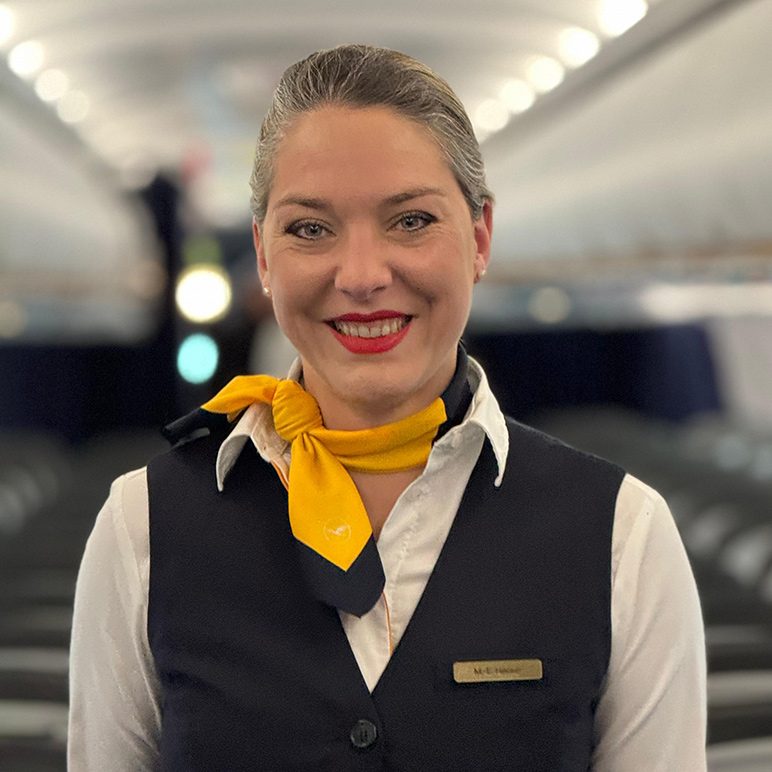
Wearing the uniform for the first time was an equally meaningful moment for me. It immediately created a sense of belonging. With that uniform, I became part of a community in which people from all backgrounds come together and work as one. That wealth of perspectives and experiences continues to be a source of inspiration to this day.
And although we are constantly assigned to new crews, some of those connections have grown into lifelong bonds. I have a “flying mom” who has become as close to me as a second mother. And I have a friend who is now my maid of honor.
After 14 years in the profession – and a decade in my additional role as a First Class flight attendant – I am now primarily assigned to long-haul routes. At Lufthansa, anyone looking to advance their career in the cabin must complete the SMP, a service management qualification co-developed by Lufthansa and certified by the German Chamber of Industry and Commerce (IHK) as a professional qualification in service management.
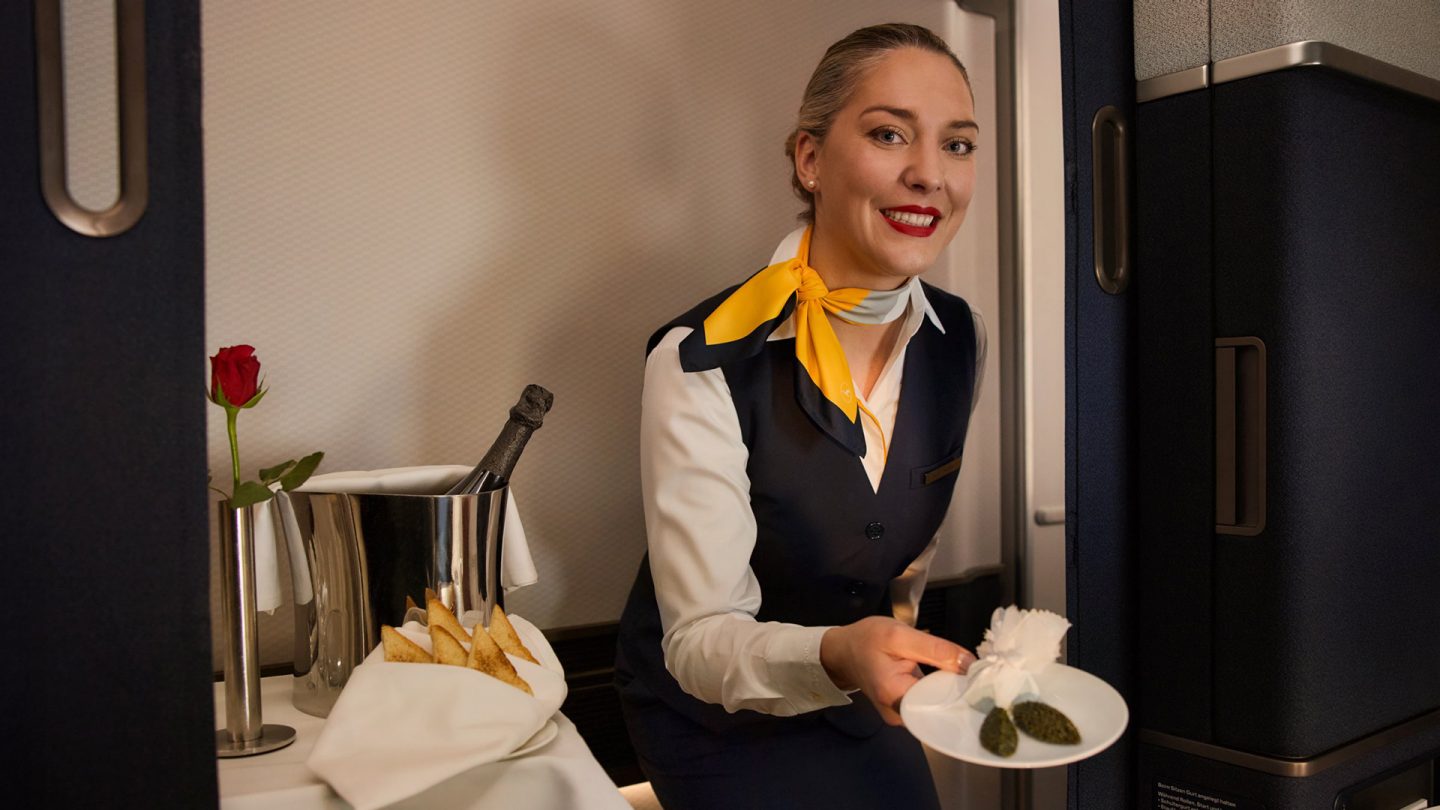
Today, the SMP is among the requirements for working in First Class or becoming a purser. First Class positions involve an additional selection process that candidates must apply for. Before joining the First Class team, we receive specialized training in refined service techniques, service etiquette, wine knowledge, and in-depth product expertise.
What remains essential for every flight attendant, however, is the regular mandatory training. Every year, we practice emergency scenarios for each aircraft type we are assigned to operate on. These are the kinds of drills that help overcome the instinctive freeze response when a real emergency occurs. We also complete annual first aid training to ensure we are prepared to respond when it matters most.
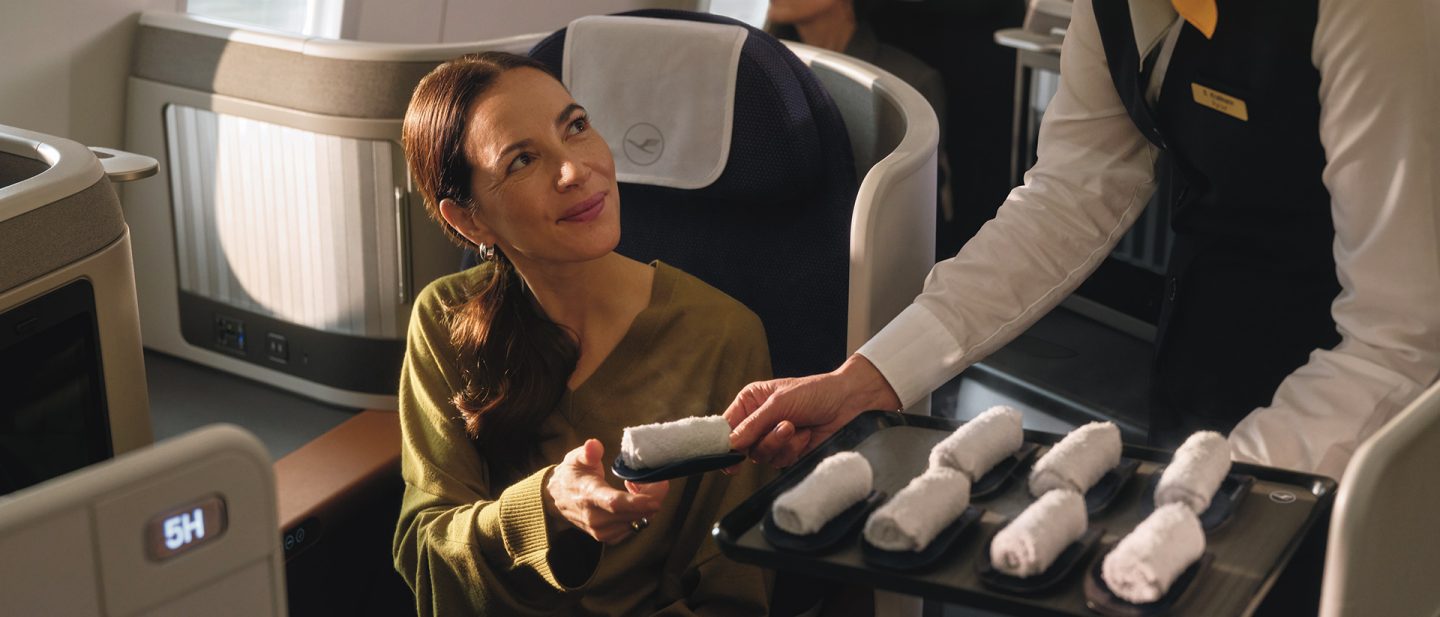
“I grew up with and alongside Lufthansa.” That sentence captures it perfectly, because this job has taught me so much. Once the aircraft door closes and is secured, I suddenly become many things at once: a safety officer, firefighter, police officer, nurse, psychologist, childcare provider, mediator – and on top of that, a server.
When someone asks me whether they should apply, I always say the same thing: the only application you will ever regret is the one you never sent.
About
Marie Hecker has been a flight attendant with Lufthansa at the Munich hub for 14 years. For the past ten years, she has been flying primarily on long-haul routes in First Class. She is also part of the PR team in Munich, where her responsibilities include assisting new flight attendants with their uniform fitting and working on special flights.

Ready to enjoy the hospitality of our crew?
Book a flight to your dream destination – our flight attendants look forward to welcoming you on board.