


The dream of flying
Human beings have constantly reinvented aviation – screw by screw, rivet by rivet, carbon fiber by carbon fiber. Since 1926, Lufthansa has been an innovation hub and one of the forces setting the pace of these developments, launching aircraft that have opened up new destinations, redefined ranges, and set standards of comfort and reliability.
Discover some of the iconic designs that contributed to this progress. Join us as we take off into the story of Deutsche Luft Hansa’s first aircraft and the “Queen of the Skies” to the latest jets.
Pioneers of passenger aviation


From 1926 to about 1930, Deutsche Luft Hansa’s first aircraft were predominantly small transport and mail planes that embodied the transition from pioneering flights to commercial aviation. These included aircraft such as the Dornier Komet III, the Junkers G 38, and the Dornier Do J “Wal” [Whale]. In those early days, two models were particularly striking:
Junkers F 13
The “mother of all commercial aircraft”, the Junkers F 13, was launched in 1919 as the first cantilever, all-metal passenger aircraft with a corrugated metal skin. Its four passengers enjoyed an enclosed, heated cabin that was revolutionary for its time. The lightweight, robust duraluminum fuselage made it ideal for the fledgling scheduled airline industry. By the early 1930s, over 300 such aircraft had been built, a technological milestone from which the later Lufthansa fleet developed.

Engine
Junkers L 5, 6-cylinder engine with 22,920 cc and up to 310 hp
Speed
Maximum speed c. 170 km/h
Cruising speed c. 140 km/h
Take-off weight
1,800–2,000 kg
Range
1,000–1,200 km
Seats
2 crew in an open cockpit plus 4 passengers in a closed cabin
Focke-Wulf A 17a “Möwe” [Gull]
At the end of the 1920s, the Focke-Wulf A 17a was an important economic pillar of the early Deutsche Luft Hansa, carrying about 12% of the company’s total scheduled air traffic. The high-wing, cantilever monoplane, built using composite materials, provided an enclosed cabin for up to ten passengers and boasted a range of around 800 kilometers. It was ideal for domestic German and European routes such as Berlin–Zurich or Berlin–Paris, and constituted an important step towards a regular passenger service.
Engine
Gnome-Rhône 9A Jupiter, 9-cylinder radial engine,
28,700 cc with 480 hp
Speed
Maximum speed c. 200 km/h
Cruising speed c. 170–175 km/h
Take-off weight
4,000 kg
Range
800 km
Seats
2 crew in a closed cockpit plus 8–10 passengers in the cabin

“Aunt Ju” – the backbone of an era
The Junkers Ju 52/3m remains probably one of the most famous German passenger aircraft, and became Lufthansa’s flying trademark. The three-engined, corrugated-metal transporter could accommodate up to 17 passengers. It was considered extremely reliable and, thanks to its robust construction, could take off and land even on short, makeshift runways.
In 1932, Lufthansa took possession of its first Ju 52, and soon this type comprised roughly half of the fleet, operating on routes from Berlin to London, Paris, and across the Alps. Its combination of low cruising speed, docile handling, and high fuel efficiency made the “Aunt Ju” the backbone of the scheduled air service in Europe. The Junkers Ju 52/3m was also deployed on spectacular test flights and special missions, such as the 1937 flight D-ANOY from Berlin across the Pamir Mountains to China. The Ju 52 was not only used in civil aviation, however. During the Second World War it was used by the Luftwaffe as a transport and supply plane, for training military pilots, and as a bomber.
The Junkers Ju 52/3m remains one of the defining symbols of the early years of modern passenger air travel. But at the same time the “Aunt Ju” embodies a chapter in Lufthansa’s history that is inextricably linked with the National Socialist regime.
Please note that with this link you are visiting an external website that may not follow the same privacy, security or accessibility policies.

Engine
3 × 9-cylinder BMW 132 radial engines, each 27,689 cc and approx. 660–725 hp → total capacity c. 2,000 hp
Speed
Maximum speed c. 250–265 km/h
Cruising speed c. 180–200 km/h
Take-off weight
9,600–10,500 kg
Range
1,300 km
Seats
15–17

Quiet turboprop over Europe
With the British Vickers Viscount 814, Lufthansa entered the era of the turboprop. From 1958 on, eleven Viscounts set new standards in domestic German and European scheduled services. Four Rolls-Royce Dart engines ensured significantly quieter, faster, and less vibration-prone flights than previous piston-engine aircraft such as the Convair CV-340, making the “Viscount” a popular workhorse on European routes well into the 1960s.

Engine
4 × turboprop Rolls-Royce Dart engines, each c. 1,750–1,770 hp
→ total capacity approx. 7,000 hp
Speed
Maximum speed c. 560–575 km/h
Cruising speed c. 520–530 km/h
Take-off weight
32,800–32,900 kg
Range
2,200–3,000 km
Seats
71–75
Last star of the prop plane era
In the mid-1950s, the Lockheed Super Constellation and its flagship model, the L-1649A Starliner – marketed by Lufthansa as the “Super Star” – launched Lufthansa into the wide world of North Atlantic routes. In 1955, an L-1049G inaugurated the transatlantic service to New York, followed in 1957 by the “Super Star” as the new flagship, carrying up to 99 passengers and, from 1958 onward, featuring the exclusive Senator Class. Four powerful piston engines and large auxiliary fuel tanks enabled nonstop flights from Hamburg to New York – journeys of up to 17 hours across the ocean that offered a high level of comfort for the time and a range of over 10,000 kilometers.
In technical terms, the American Lockheed Super Constellation represented the culmination and, at the same time, the end of large propeller-driven, long-haul aircraft at Lufthansa. Today, a faithfully restored L-1649A has returned as the centerpiece of the new Lufthansa Conference and Visitor Center, and as a brilliant reminder of an era when luxury airliners with radial engines on its wings and triple tails were conquering the Atlantic. The legendary “Super Star” design of that era now lives on, as it features in the retro-styled livery on the fuselage of an Airbus A320-200.


Engine
4 × 18-cylinder, two-row radial Wright R-3350 engines, each 54,870 cc and c. 3,400 hp
→ total capacity approx. 13,600 hp
Speed
Maximum speed c. 540–600 km/h
Cruising speed c. 480–500 km/h
Take-off weight
72,500 kg
Range
9,500–10,000 km
Seats
60–80
Big birds across the Atlantic
For Lufthansa in 1960, the Boeing 707 marked the beginning of the Jet Age. The four-engine jet halved travel time on the North Atlantic route, could carry some 140 passengers, and was quieter and less prone to vibration than its propeller-driven predecessors. On average, one 707 replaced four Super Constellations, definitively establishing Frankfurt as the hub of global jet traffic.
Engine
4 × Rolls-Royce Conway Mk.508 turbofan engines, each with c. 80 kN of thrust
→ equivalent to c. 42,880 hp
Speed
Maximum speed c. 1,000 km/h
Cruising speed c. 880–900 km/h
Take-off weight
151,000 kg
Range
7,500–9,000 km
Seats
148

City Jet – short-haul innovations
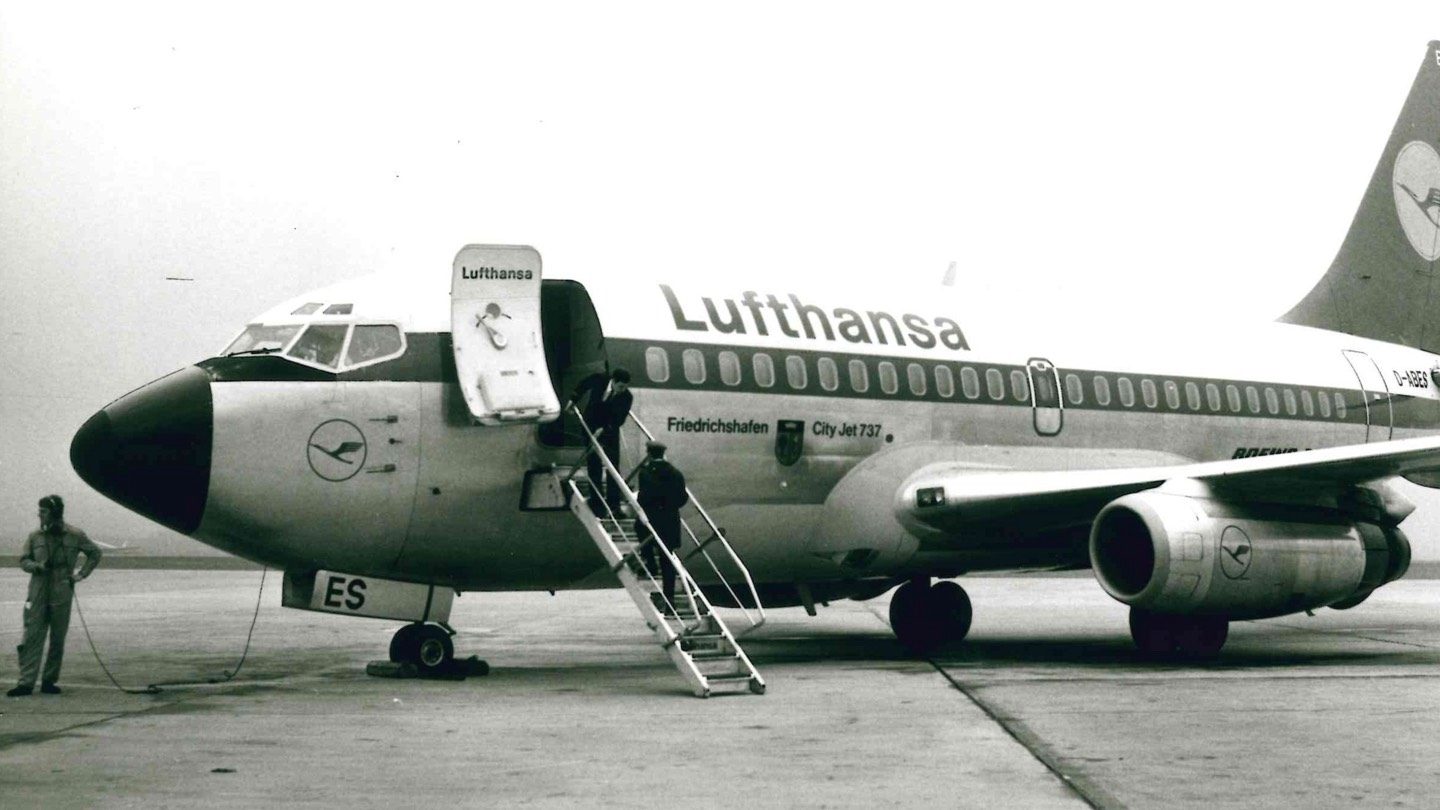
In 1968, Lufthansa introduced the Boeing 737 as the “City Jet”, launching short-haul flights too into the Jet Age. Chief Technology Officer Gerhard Höltje and the engineers at Lufthansa Technik were instrumental in powering Boeing’s development of a completely new short-haul jet in the first place. Based on detailed specifications for the cabin, engine configuration, and ease of maintenance, they came up with a design specifically tailored to European city connections, featuring low landing gear, rapid turnaround, and some 100 seats. In 1965, Lufthansa was the first customer worldwide to place a series order for this aircraft. The Boeing 737-100’s maiden flight took place on April 9, 1967; Lufthansa began operating the first aircraft in the series in February 1968.
The 737 got its nickname of “Bobby” from a children’s book in which the 707 was the father (in a later edition, it’s the Boeing 747), the 727 the mother, and the 737 the child “Bobby” – a name that Lufthansa employees affectionately adopted.
Engine
2 × Pratt & Whitney JT8D 15 turbofan engines, each with c. 96 kN of thrust
→ equivalent to c. 25,800 hp
Speed
Maximum speed c. 930 km/h
Cruising speed c. 820–850 km/h
Take-off weight
50,800–52,400 kg
Range
3,000–3,200 km
Seats
90–100
Queen of the Skies – Lufthansa enters the Jumbo era
When Lufthansa launched its first Boeing 747 on the Frankfurt–New York route on April 26, 1970, it represented a new kind of flying. The “Jumbo” weighed over 300 tonnes fully fueled, boasted seating for 365 passengers, and its two aisles made service faster and more personalized. On board, passengers could look forward to film screenings, musical programs, and a staircase leading up to the exclusive lounge on the upper deck – a flying living room above the Atlantic.
The 747, soon reverently dubbed “Queen of the Skies”, became a symbol of global innovation: It lowered unit costs, opened up long-haul flights to a growing middle class, and definitively established Frankfurt as an international hub. The year 1972 saw the advent of the freighter version of the 747 with its hinged nose, capable of carrying up to 100 tonnes of cargo, or, figuratively speaking, the equivalent of 72 VW Beetles – another milestone in the success story of this exceptional aircraft.
Working together with Boeing, Lufthansa went on to develop the Jumbo further, with the Boeing 747-400 in the late 1980s and its successor, the 747-8, from 2012 onwards representing iconic examples of this collaboration.
Engine
4× Pratt & Whitney JT9D-3A turbofan engines, each with c. 193 kN of thrust
→ equivalent to c. 103,500 hp
Speed
Maximum speed c. 960 km/h
Cruising speed c. 910 km/h
Take-off weight
334,000 kg
Range
8,500–9,800 km
Seats
365


Three-engine globetrotter serving Far East destinations
From 1974, Lufthansa enhanced its fleet of Jumbo jets with the addition of the McDonnell Douglas DC-10-30 on long-haul routes with medium-scale passenger volume. The three-engine, wide-body aircraft, with its characteristic engine mounted in the tail, provided seating for around 250 passengers and primarily offered connections with destinations in South America and the Far East, such as Frankfurt–Rome–Karachi–Delhi–Bangkok–Hong Kong–Tokyo. Until 1994, the DC-10 reliably transported over 42 million Lufthansa passengers around the world.
Engine
3 × General Electric CF6-50C turbofan engines, each with c. 227–240 kN of thrust.
→ equivalent to c. 96,000 hp
Speed
Maximum speed c. 950 km/h
Cruising speed c. 900 km/h
Take-off weight
259,000 kg
Range
9,500–10,500 km
Seats
250–270

The first European wide-body jet – the Lufthansa Airbus A300

With the Airbus A300, Lufthansa became the first German airline to introduce a true wide-body jet on short- and medium-haul routes in the mid-1970s. As one of the key customers of the fledgling Airbus consortium, Lufthansa directly incorporated its operational requirements into the development of the aircraft, from cabin layout to ground handling. The result was a twin-engine wide-body that competed with American designs and at the same time set new European standards.
The A300’s two-aisle cabin – 39 meters long and just over 5 meters wide – was designed to carry some 250 passengers, 24 in First Class and 229 in Economy. Three generously sized galleys enabled a level of service previously the preserve of long-haul jets. Below deck, the A300 could accommodate standardized containers and pallets – a step towards the seamless integration of passenger and cargo operations.
Engine
2 × General Electric CF6-50C1 turbofan engines, each with c. 233–236 kN of thrust
→ equivalent to c. 63,500 hp
Speed
Maximum speed c. 910 km/h
Cruising speed c. 870 km/h
Take-off weight
165,000 kg
Range
5,300–5,800 km
Seats
250–270

In its day-to-day operations, the A300 proved the advantages of a fuel-efficient, high-performance twin-engine jet on busy European routes. For Airbus, it became the entry-level aircraft on the global market, while for Lufthansa, it was a visible symbol of European unity in the aviation industry – and the forerunner of the subsequent Airbus family of A310s to A380s.
Lufthansa played a key role in the design of the A300’s successor and spearheaded the Airbus A310 project. The airline demanded a lighter, long-range wide-body jet with the smallest possible wing area and wingspan for flying in busy traffic over Europe. These requirements shaped the wing design and aerodynamic concept that later became the groundbreaking supercritical airfoil.
Fly-by-wire for Europe – the A320 family of aircraft
Starting in the mid-1980s, Lufthansa introduced into its fleet what was then the most modern commercial aircraft – the Airbus A320 family. As one of the early customers, the airline was closely involved in its development and helped define a standardized cockpit layout for all small Airbus jets. For the first time, a digital fly-by-wire system was in control of the aircraft, reducing weight and fuel consumption while increasing operational safety.
1980s

Engine
2 × CFM International CFM56-5A/-5B turbofan engines, each with c. 111 kN of thrust
→ equivalent to c. 30,000 hp
Speed
Maximum speed c. 890 km/h
Cruising speed c. 850 km/h
Take-off weight
73,500 kg
Range
4,800–6,150 km
Seats
150–168
With the latest A320neo generations, featuring a quieter cabin and even more fuel-efficient engines, Lufthansa is continuing this development: Compared with earlier variants, fuel consumption per seat is significantly reduced, while range and comfort are increased. The A319, A320, A321, and their neo versions now form the efficient backbone of the European network.
2026

Engine
Pratt & Whitney PW1127G-JM, each with c. 120 kN of thrust
→ equivalent to c. 32,000 hp
Speed
Maximum speed c. 890 km/h
Cruising speed c. 840 km/h
Take-off weight
79,000 kg
Range
6,850 km
Seats
165–194
Superlative double-decker
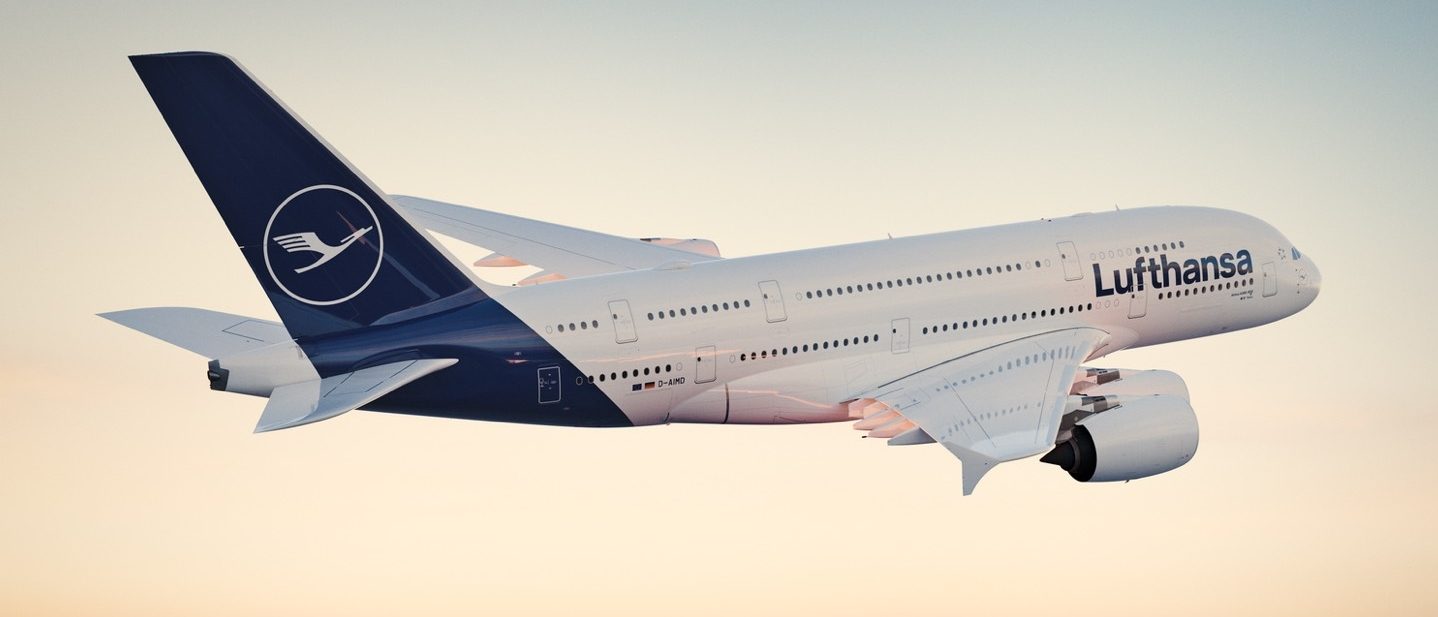
In 2010, with the launch of the Airbus A380, Lufthansa entered the era of mega-wide-body jets. Depending on its configuration, this double-decker, four-engine aircraft provides seating for over 500 passengers which means that high-demand routes such as Frankfurt–New York or Frankfurt–Shanghai can operate with fewer flights – a significant advantage when slots are limited. Modern engines, the extensive use of lightweight composite materials, and a quiet cabin make the Airbus A380 an efficient flying brand ambassador.
Engine
4 x Rolls-Royce Trent 970/972-84 turbofan engines, each with c. 334–348 kN of thrust
→ equivalent to c. 180,000 hp
Speed
Maximum speed c. 960 km/h
Cruising speed c. 940 km/h
Take-off weight
560,000 kg
Range
15,000 km
Seats
509
The “raccoon mask” on long-haul
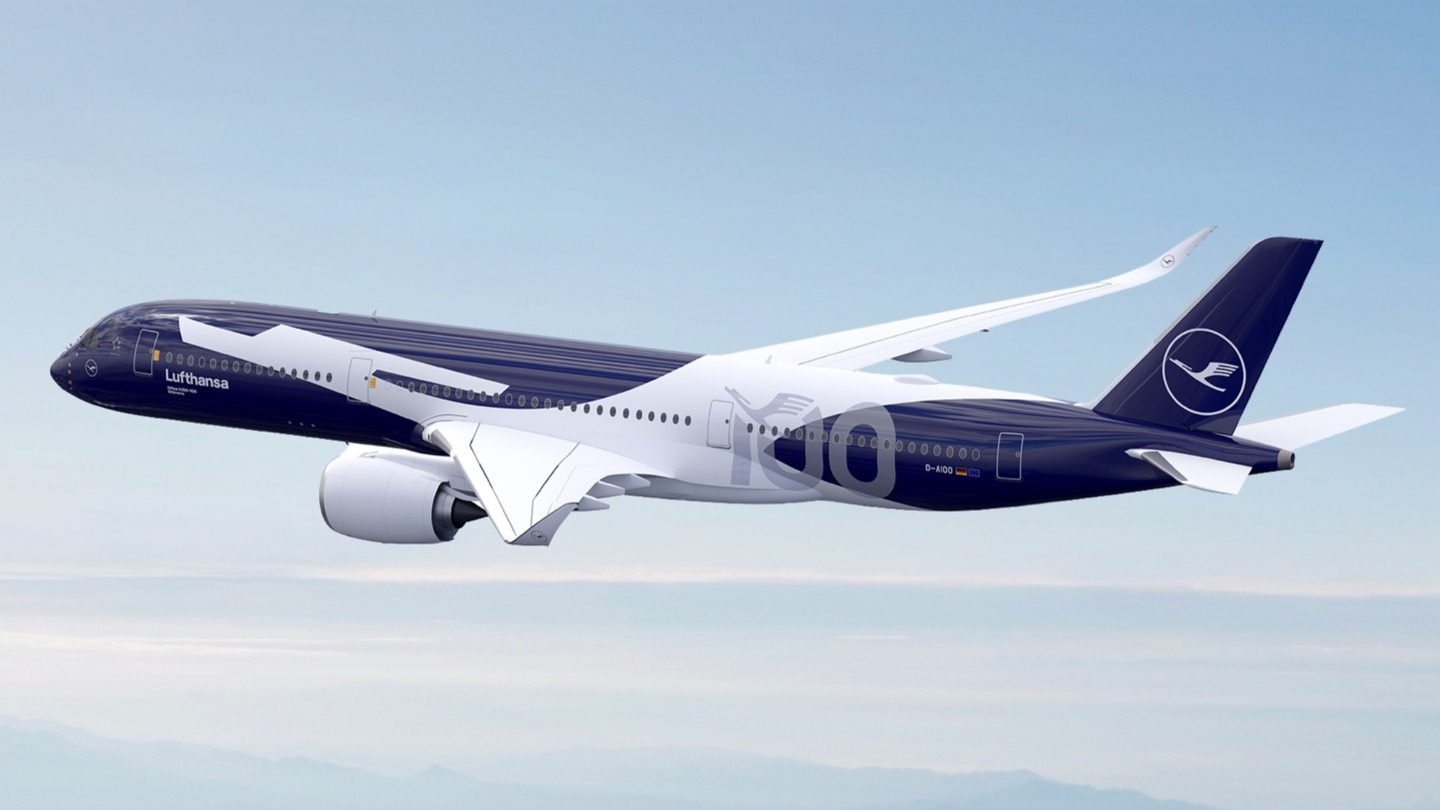
With the Airbus A350-900, Lufthansa has had its most technologically advanced long-haul aircraft in the fleet since 2016, thus gradually phasing out the four-engine era. The twin-engine aircraft, with its consistent lightweight design, modern Rolls-Royce engines, and approximately 293 seats, is gradually replacing the A340-300 and the A340-600.
Inside, generously sized windows, higher cabin pressure, improved humidity, and a flexible lighting concept make the travel experience even more comfortable. The cabin is specifically designed for long-haul overnight flights and busy daytime routes. For crews, the A350 is considered a “next-generation cockpit.” A cockpit with large digital screens, modern systems, and a long range make the A350 a versatile long-haul aircraft serving North America, Asia, and, in the future, premium markets with increased First Class demand – fitted increasingly with the new Lufthansa Allegris generation of cabins.


Its larger sibling, the A350-1000, further reinforces this role: At almost 74 meters long, it offers around 15 percent more capacity than the A350-900, making it ideal for busy routes with a high volume of premium passengers. With a total of 75 A350-900s and A350-1000s on order, this aircraft type is becoming a strategic pillar of Lufthansa’s long-haul fleet – a generational shift that will shape technological standards, product quality, and fleet structure for the long term.

Engine
2 × Rolls-Royce Trent XWB-84 turbofan engines, each with c. 375 kN of thrust,
→ equivalent to c. 100,000 hp
Speed
Maximum speed c. 960 km/h
Cruising speed c. 910 km/h
Take-off weight
283,000 kg
Range
15,000–15,750 km
Seats
267–293
Dreamliner – in the true sense of the word
The Boeing 787-9, also known as the Dreamliner, has since 2022 been enhancing Lufthansa’s A350 fleet as a modern twin-engine aircraft on long-haul routes, filling capacity gaps until the 777-9 arrives. With its quiet cabin, large dimmable windows, and contemporary onboard product, the Dreamliner primarily operates routes to North America and Asia. At the same time, the 787-9 symbolizes the fleet’s transformation: By 2026, more than 20 aircraft – many featuring the new Lufthansa Allegris cabin – are expected to be operational, replacing older, four-engine aircraft.

Engine
2 × General Electric GEnx-1B74/75 turbofan engines, each with c. 330–331 kN of thrust
→ equivalent to c. 88,000 hp
Speed
Maximum speed c. 950 km/h
Cruising speed c. 915 km/h
Take-off weight
254,000 kg
Range
17,000 km
Seats
287–294
The dream of flying goes on...
But this isn’t the end of the story. Digital services and cabin concepts such as Lufthansa Allegris demonstrate how the skies are constantly changing – becoming quieter, more comfortable, and more connected. This naturally includes new generations of aircraft, such as the Boeing 777X, a new product based on the 777. In this, Lufthansa is once again setting the pace and serving as the launch customer.
At the same time, aviation is facing major challenges. More efficient fleets and new technologies are fundamentally changing the face of travel. Passengers on board today are part of this next chapter and are helping to shape a future of flying that combines responsibility with fascination.

Note on the aircraft technical data
All technical specifications regarding engines, speed, range, weight, and seating capacity are based on historical sources, manufacturers’ data, and various secondary sources. Particularly for aircraft models from the 1920s and 1930s, the data is sometimes inconsistent: Different model and engine variants, subsequent modifications, the operational profiles of the respective operators, and varying methods of measurement and rounding-off produce differing values. Consequently, conflicting figures are sometimes found online. The figures given here should be taken as carefully researched, rounded guidelines, not as standard reference data in every detail, and do not replace official manufacturer or certification documents.
Note on the engine power specifications
In the case of jet engines, the technically correct power output is given in kilonewtons (kN) of thrust. To enable comparison with the piston and turboprop aircraft cited in this history, the thrust values of the jet engines have been converted into “horsepower equivalents” (rule of thumb: 1 kN ≈ 134 hp). These values should be taken as rough comparative figures, serve solely for illustrative purposes, do not represent technical or certification-relevant performance data, and in particular do not replace precise thrust-based performance specifications.